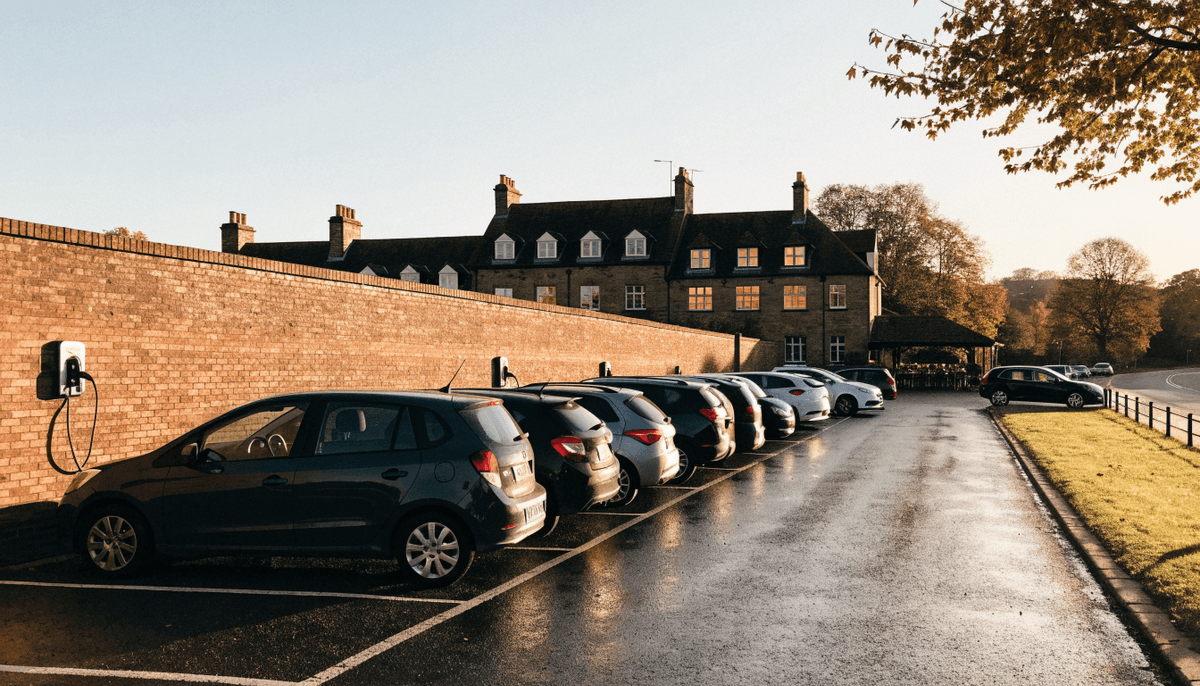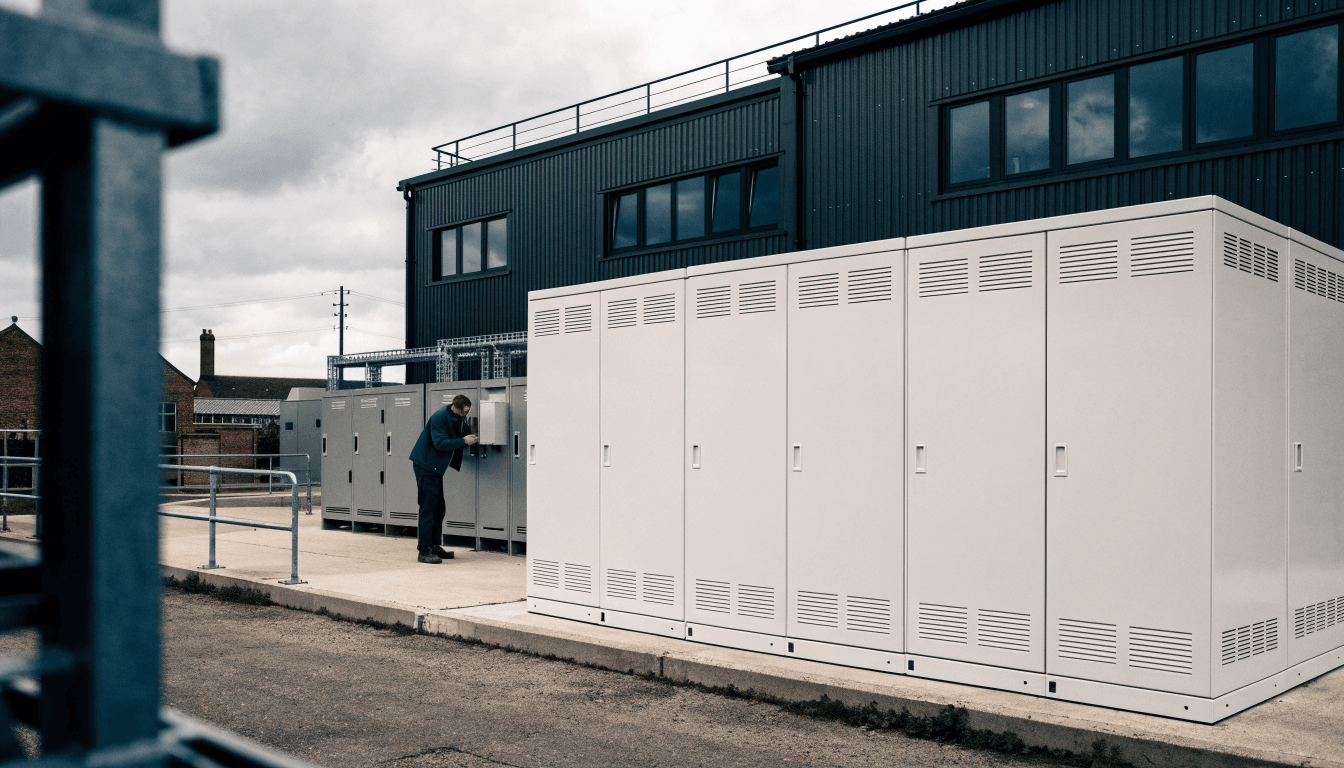
From 21 October, your car park can take a proper charging hub without planning permission. Read the small print first.
England's permitted development rules change on 21 October 2026: non-domestic car parks can now have multiple units of EV equipment housing up to a combined 45 cubic metres without a planning application. Here's what changes, what doesn't, and the small print.
On 21 October 2026, England's planning rules for EV charging change. Most of the coverage has been about households without driveways and pavement cable channels. Fair enough — that's the bit that affects millions of drivers.
But tucked into the same order is the change that matters if you run a car park: the one-cabinet limit on charging kit in non-domestic car parks is gone. From 21 October you can put up several units of equipment housing, up to a combined 45 cubic metres, without a planning application.
If you're planning anything bigger than a handful of 7kW posts, that's worth knowing before you sign a quote. Here's what changes, what doesn't, and the small print that still catches people out.
What the law actually says
The instrument is the Town and Country Planning (General Permitted Development) (England) (Amendment) (No. 2) Order 2026 — SI 2026/1056. It was made on 25 September, laid before Parliament on 30 September, and comes into force on 21 October 2026. It applies in England only.
It follows a Department for Transport consultation that drew 147 responses. On the car-park proposal, 100 respondents agreed and 14 disagreed. The government response, published in September, said it would go ahead "subject to limitations and conditions and, where appropriate, prior approval", pointing to "the scale of equipment now commonly required to support higher-capacity EV charging installations".
Translation: rapid hubs need more boxes than the old rules allowed.
Free download
Grant Eligibility Cheat Sheet 2026
WCS, DCS, EVIG and Capital Allowances on one page. Who qualifies, what's eligible, the stacking rules nobody mentions, and a 12-socket worked example.
The old rule vs the new rule
Since 29 May 2025, non-domestic off-street car parks have been allowed, without planning permission:
- One unit of equipment housing
- No bigger than 29 cubic metres
- No taller than 3 metres
- Not within 5 metres of a highway
- Not within 10 metres of a house or block of flats
- Not on a scheduled monument site or within the curtilage of a listed building
From 21 October 2026:
- The one-unit limit is removed. You can have several cabinets.
- The cap becomes cumulative: 45 cubic metres for all housing in the area — about 55% more room than before.
- The 3m height, 5m highway and 10m residential distances all stay.
- Upstands (the charger posts themselves) keep their 2.7 metre allowance in non-domestic car parks.
Why it matters: a serious hub isn't one box. The consultation itself listed "transformers, control equipment and battery systems". Under the old rule, a second cabinet — say, a battery to buffer a weak supply — could tip you into a full planning application. That's months, fees and a committee you can't control. Now, within the limits, it doesn't.
The small print
Permitted development is not "anything goes". Four conditions will trip people up.
1. Over 29 m³ on protected land needs prior approval. If your site is on Article 2(3) land — a conservation area, National Park, National Landscape (the old AONBs), the Broads or a World Heritage Site — and your combined housing goes over 29 cubic metres, you need prior approval for siting and appearance before you start. It's lighter than a full application, with a 56-day decision mechanism, but it isn't nothing. Plan for it.
2. Some land is off-limits above 29 m³. Above that cumulative figure, the right doesn't apply on Sites of Special Scientific Interest or protected European wildlife sites.
3. The 10-metre rule kills more sites than anything else. Measure from the nearest residential curtilage — and check for flats on or next to your own site. A hotel or pub with staff accommodation, or a retail park backing onto gardens, may have nowhere compliant to put the cabinets. Find that out on day one, not after the DNO quote.
4. Don't jump the gun. Until 20 October the old one-unit, 29 m³ rule applies. Install a second cabinet on the 15th and you're relying on rules that don't exist yet.
What it doesn't fix
Planning was rarely the slowest part of a charging project. These still are:
- Your grid connection. Permitted development doesn't make your DNO move faster. If the quote says three years and a reinforcement bill, read our guide to flexible connections and [what to ask about the DNO application](https://energy-partners.co.uk/insights/dno-application-ev-charging-uk).
- Landlord and lease consent. If you lease the site, the freehold owner still gets a say.
- Listed buildings and scheduled monuments. Still excluded.
- Public charging rules. Open chargers to the public and the Public Charge Point Regulations 2023 apply, including contactless payment on new chargers of 8kW and above.
- Electrical certification and Building Regulations. Same as ever.
One more helpful change sits in the same order: electricity companies can now install substations and similar apparatus up to 45 cubic metres under their own permitted development rights (up from 29), with limits near homes and on protected sites. If your connection needs a new substation, that's one less planning step on the network side.
Who should care — and who shouldn't
Let's be blunt. If you're installing six 7kW wall chargers at a gym or golf club, this changes almost nothing for you. Small AC installs rarely need a large standalone cabinet. Our cost guide still applies.
This matters if you're planning:
- A rapid or ultra-rapid hub at a retail park, leisure site, stadium or motorway-adjacent business, where a transformer, switchgear and charger power cabinets sit apart
- Battery-buffered charging on a constrained supply — the battery is now just another cabinet within the 45 m³, not a planning headache. More on the economics in our battery storage piece
- Fleet depots going from a few posts to dozens of high-power chargers
- Phased sites, where you'd add a cabinet in year two as demand grows
It also lands at a useful moment. Zapmap's latest numbers show destination chargers grew just 4% in a year while ultra-rapid grew 39%. Venues that want faster charging have one fewer reason to wait.
What about the cable-across-the-pavement change?
That's the headline grabber, and it's mostly residential. From 21 October, households can install a home charger in more parts of their property and run the cable through a pavement-embedded channel authorised by the highway authority — without planning permission. Conservation areas are excluded. That covers around 10,000 conservation areas in England, where The Times estimates about 3.4 million people have no driveway.
For a business, the knock-on is your staff. Some who couldn't charge at home now can. Those in conservation-area streets still can't — and they're the ones for whom workplace charging is the cheapest option they've got.
A five-step checklist before you commit
- Confirm you're in England. Wales and Scotland have their own regimes.
- Check your land status. Conservation area, National Landscape, National Park, SSSI, listed building nearby? Your council's planning map will tell you in minutes.
- Measure the distances. 5m from any highway, 10m from any residential curtilage. Mark a compliant zone on a site plan.
- Total the housing volume. Ask your installer for the external dimensions of every cabinet, transformer and battery. Add them up. Under 29 m³, over 29 m³, or over 45 m³ — each is a different route.
- Get it in writing. For bigger projects, a Lawful Development Certificate from your council confirms the work is permitted. It's cheap insurance against a neighbour's complaint.
The bottom line
The 21 October change won't make headlines in the business press. It should. It removes a planning barrier from exactly the kind of multi-cabinet hub that UK car parks have been slow to build.
It doesn't fix grid queues, lease negotiations or the 10-metre rule. But for a properly designed hub, "do we need planning permission?" is now, more often, "no — as long as you measure first."
Check what your site can take
We'll look at your land status, map the compliant zone for equipment, size the housing against the 45 m³ limit, and tell you straight whether you need planning, prior approval or neither. Then we'll check your supply and give you a fixed written quote.
Energy Partners
Energy Partners — commercial energy specialists for UK businesses.