Stadium and matchday EV charging: the 90-minute revenue trick
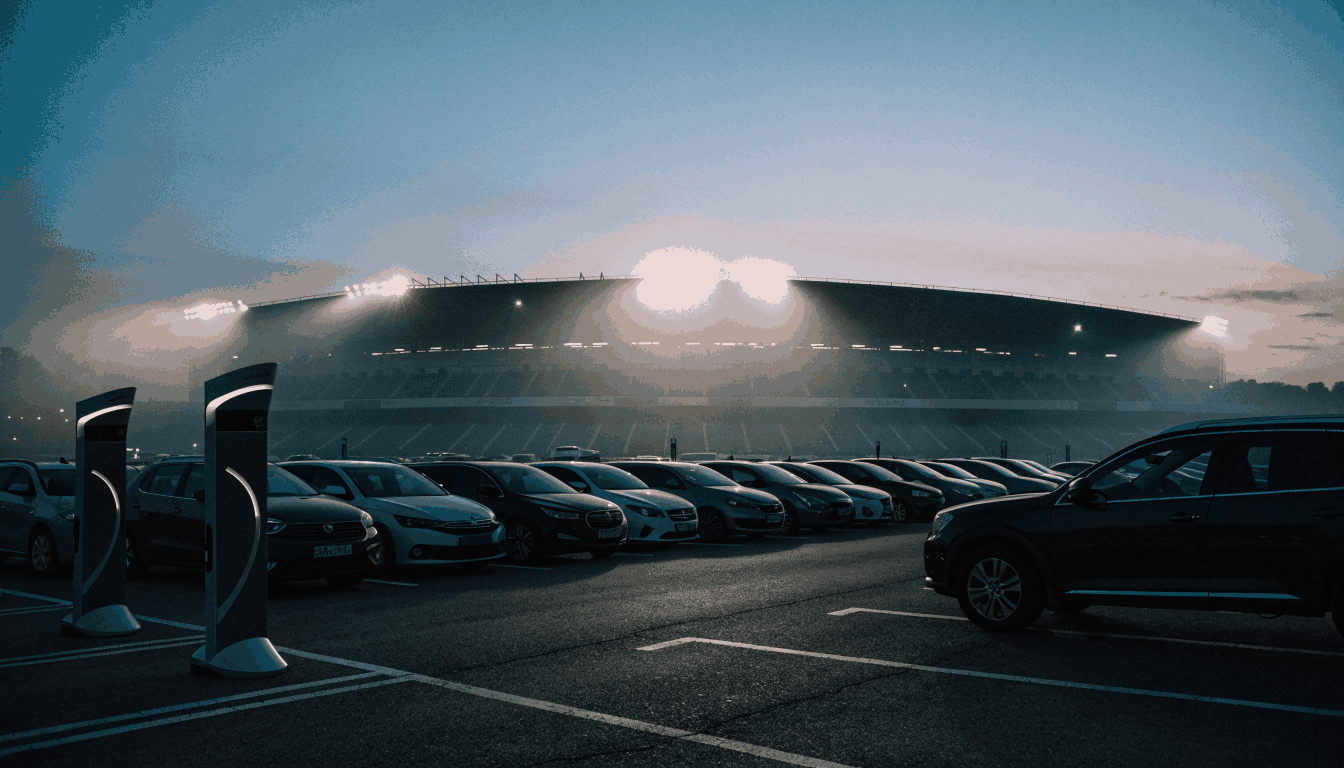
90 minutes of dwell. 25,000 cars. One concentrated 4-hour window per matchday. Stadium EV charging isn't "destination charging" — it's an entirely different operational model nobody's modelled.
25,000 cars. 90 minutes of concentrated dwell. A 4-hour matchday window. And then six days of underused car park. Stadium EV charging is genuinely a different beast — it breaks the maths of standard destination charging, and most installers don't know what to do with the profile.
If you operate a UK stadium, arena or large outdoor venue, this post is for you. It is not a generic "destination charging" piece. The 90-minute window changes everything about charger choice, queue management, and revenue model.
Why standard destination charging maths breaks at stadiums
A retail park assumes steady all-day flow, 60-90 minutes of typical shopping dwell, mixed dwell durations. The numbers smooth out. A stadium does not smooth out.
- Matchday: 25,000 cars arrive over 2 hours, dwell for 3-4 hours, leave over 60 minutes
- Off-matchday: the car park is empty or used for staff
- Concert nights: similar profile to matchday but irregular dates
- Conference / event days: smaller, longer dwell, different car mix
The challenge isn't whether to install chargers. It's how to monetise a charger fleet that's heavily-used on 25-40 matchdays per year and lightly-used on the other 320.
Free download
Retail Park Charger P&L
Two 50kW DC chargers, full P&L through year two, tariff strategy, idle fee defence.
Three operational models that actually work
Model 1 — VIP and sponsor-only. 8-12 ultra-rapids in the premium parking area, reserved for box-holders and sponsors. Branded ("Charge by [sponsor]"). The revenue isn't charging — it's the sponsorship deal. Annual value: £40,000-£120,000 depending on club profile.
Model 2 — Season-ticket members. 30-60 chargers spread through GA parking, accessible only to season-ticket-holding EV drivers via membership card. Tariff: free or subsidised, baked into the season ticket. Brand benefit: retention plus premium perception. Membership uplift: measurable in renewal data within 2 seasons.
Model 3 — Public hub. The stadium car park becomes a commercial DC charging hub on non-matchdays, open to the public, with revenue collected by a charge-point operator on a revenue-share or lease model. Matchday: reserved for ticket-holders. Annual revenue (public hub portion): £15,000-£60,000 per stall depending on traffic flow.
The smart operators stack all three. VIP charging for the premium tier, season-ticket charging for the loyalty tier, public hub revenue for the rest of the week.
The matchday spike — load management is everything
A naive stadium install assumes all chargers can run at full power simultaneously. That works fine for 8 chargers. Not for 60.
A 60-charger hub at 22kW each = 1.32 MW of demand. At 50kW DC each = 3 MW. That's transformer territory — and the DNO will quote you accordingly.
The fix is load management software that intelligently throttles each charger based on (a) current grid headroom, (b) priority rules (season tickets first, public last), (c) anticipated kick-off and final-whistle peaks. Done well, you can run 60 chargers off a sub-1 MW connection without anyone noticing a slower charge.
This is the bit where the wrong installer costs you twice — once on the over-spec grid upgrade you didn't need, once on the under-spec install that brown-outs the car park lighting on a Saturday at 3pm.
Queue management and signage — the dimension nobody plans for
Stadium charger management isn't electrical engineering. It's crowd-flow engineering. Key decisions:
- Pre-booking via app for matchday — eliminates the queue at gates
- Time-limited sessions (3 hours typical) so the post-match clearout doesn't get clogged
- Visible "available now" signage at car park entry — phone-app guidance to a specific bay
- Stewarding integrated with existing matchday operations
The clubs that get this right report EV-driving season ticket holder retention rates ~5-8% higher than the broader base. The clubs that don't get angry letters and a small but persistent social media following dedicated to documenting their dead chargers.
The off-matchday revenue case
Here's the slot most stadiums miss. The car park is empty Mon-Fri 9am-5pm. It's on or near a major route. A 50kW DC hub of 8-12 chargers, open to public commuters and through-traffic, can generate £100,000-£300,000 in annual charging revenue with the right CPO partnership.
For a club with a 25,000-seat car park, that's a six-figure revenue line on infrastructure that's otherwise depreciating in the rain.
It's already happening: Sunderland AFC's 20-bay hub
The clearest proof-of-concept so far is in the Premier League. In October 2026, Sunderland AFC and charge point operator RAW Charging opened a 20-bay ultra-rapid hub at the Stadium of Light — 16 bays rated at 150kW, 4 capable of up to 300kW, running entirely on renewable energy. RAW Energy is funding the roughly £750,000 build and will own, operate and maintain the infrastructure; Sunderland supplies the site under its "Ready Eco" sustainability programme. It's open to supporters and the wider public, takes contactless payment and the major charging apps. RAW Charging's CEO, Jason Simpson, called it "the largest EV charging hub in the North East"; Sunderland's chief operations officer, Paul Kingsmore, framed it as part of the club's wider commitment to "making a real difference through our Ready Eco programme."
That's Model 3 from above, running at full stadium scale: the club carries no charging capex or operating risk, the operator takes the revenue and the usage data, and a car park that used to earn on 25-40 matchdays a year now earns on all 365. It's the template worth copying, not just admiring.
A worked example — 20,000-seat football club
Site: Mid-table EFL Championship club, urban location, ~3,500 car parking spaces.
Install:
- 12 × 50kW DC ultra-rapids (public hub corner, sponsor-branded)
- 40 × 22kW twin AC posts (season ticket member zones)
- Load management software + transformer upgrade
- Capex: £680,000
Grants applied:
- Depot Charging Scheme (if the club's commercial fleet uses the site): 70% of eligible cost
- Without DCS: ~£480,000 net capex
Year-one revenue:
- Sponsor deal for VIP chargers: £75,000
- Public hub charging margin (50kW DC at typical commuter traffic): £165,000
- Season ticket retention uplift (~150 EV-driving STH retained vs lost, at £600 ARPU): £90,000 incremental
- Total Y1 benefit: ~£330,000
Payback on net capex: ~18 months. Plus matchday brand value and customer-experience uplift (unquantified, real).
What to ask before you commit
- "Have you done a stadium-scale install before? Show me the load profile."
- "What's the DNO conversation — and what's the load-management software you'll use?"
- "What CPO partnerships do you have for the off-matchday public hub?"
- "What's the season-ticket integration with our existing membership system?"
- "What's the matchday support model — on-site engineers, remote SLA, or both?"
The short version
Stadium EV charging is a unique operational beast — concentrated matchday peaks, six days of underuse, different commercial models for VIP, member and public segments. Stack all three revenue streams and a typical Championship club install pays back in under 2 years. Off-matchday public charging is the most often-missed revenue line, and Sunderland AFC's new 20-bay hub with RAW Charging shows exactly what it looks like at full scale.
Talk to us about your venue. Get in touch and we'll walk you through a stadium-specific operating model in a 45-minute call.
Source: electrive.com, 6 October 2026
Energy Partners
Energy Partners — commercial energy specialists for UK businesses.