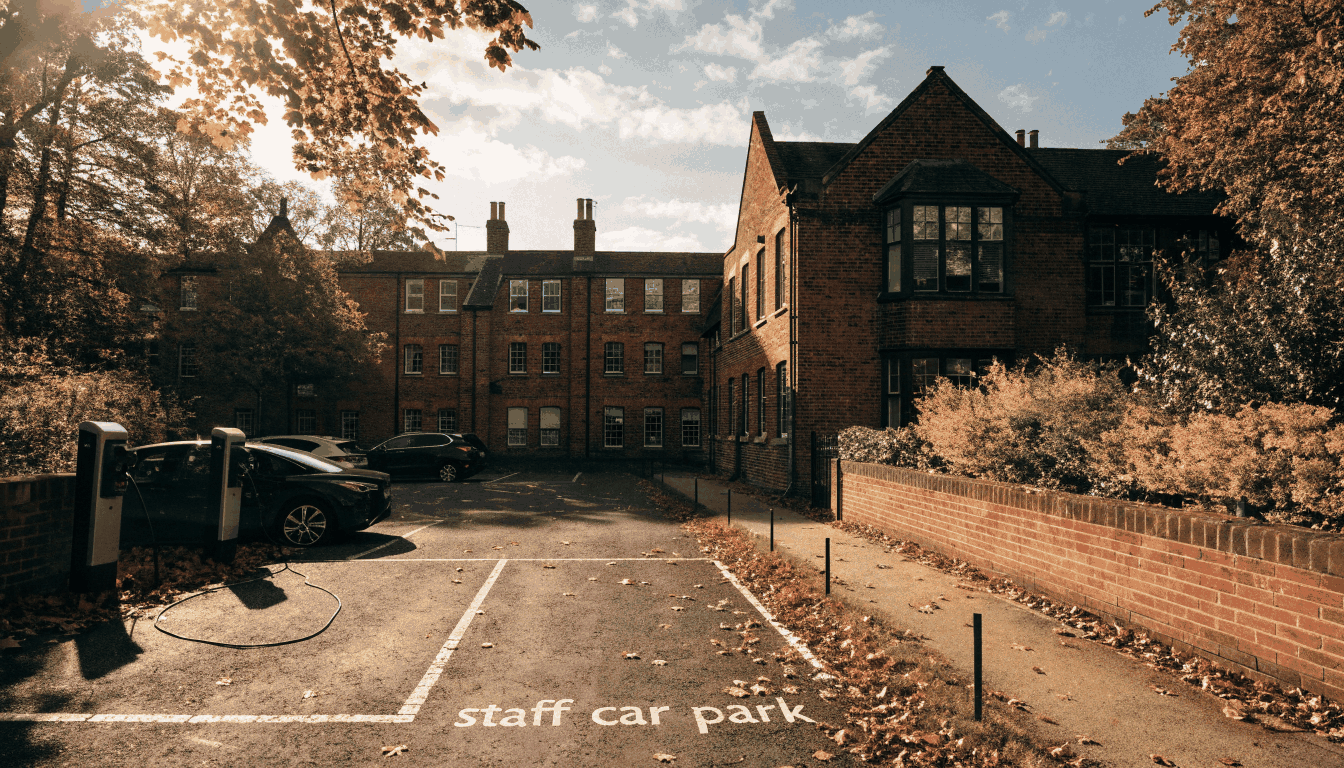
EV charging in schools and universities: Salix funding, parent drop-off, and zero-emission fleets
Schools have minibuses. Universities have estates that look like small towns. Both have access to grant funding most facilities managers haven't read about. Both are leaving £hundreds-of-thousands on the table.
24,000 UK schools. 161 universities. One funding stack worth £hundreds-of-thousands per institution — most facilities managers have never opened the application. The education sector is genuinely the most under-served vertical in commercial EV charging in 2026, and the irony is that it's also the best-funded.
This post is for school business managers, multi-academy trust CFOs, university estates teams, college finance officers, and anyone trying to make the EV transition happen on a public-sector budget. Real grants, real procurement routes, real numbers.
The education-sector funding stack
You can stack three (sometimes four) sources of funding on a single project. Most installers know one. Some know two. Stack all three:
1. The Public Sector Decarbonisation Scheme (PSDS), administered by Salix Finance. Pays for low-carbon heating, insulation and EV infrastructure at public-sector sites. Schools, academies, FE colleges, universities and NHS estates all qualify. Grants typically cover 30-100% of project cost depending on phase and project type. Phase 4 (2026-27) has £940 million allocated.
2. The Workplace Charging Scheme (WCS). State-funded schools and academy trusts don't use the standard business rate — there's a dedicated Workplace Charging Scheme for state-funded education institutions paying up to £2,000 per socket (75% of cost, for applications from 1 April 2026; up to £2,500 per socket if applied for and redeemed before that date), capped at 40 sockets — and an academy trust can claim that 40-socket cap separately for each school it runs, not once for the whole trust. Independent (fee-paying) schools don't qualify for that rate and fall back to the standard business scheme: up to £500 per socket (from 1 April 2026; £350 before), same 40-socket cap, 75% of cost. Universities and FE colleges should confirm which rate their estate qualifies for directly with the scheme administrator before budgeting — treatment isn't uniform and depends on funding status. Stacks with PSDS as long as funding doesn't exceed 100% of project cost (it won't).
3. The Depot Charging Scheme (DCS). If the school or university operates 5+ vehicles as a fleet (minibuses, vans, ground-maintenance), the depot qualifies. 70% of chargepoint and civils cost up to a £1m cap. Genuinely transformative for any institution with a transport function.
4. Capital allowances. If the institution is corporation-tax-paying (some MATs run trading subsidiaries, universities run commercial arms), 100% first-year allowance on the net cost after grants. For non-tax-paying entities, irrelevant.
The trick most facilities teams miss: you can apply for multiple grants on the same site as long as they don't fund the same socket twice. Different sockets, different funding pots, one project.
Free download
Grant Eligibility Cheat Sheet 2026
WCS, DCS, EVIG and Capital Allowances on one page. Who qualifies, what's eligible, the stacking rules nobody mentions, and a 12-socket worked example.
Schools — three use cases worth the grant work
Use case 1: Staff parking. The simplest play. A state-funded school or academy can claim up to £2,000 per socket under the education-rate WCS for 4-12 sockets in the staff car park — often covering most of the install cost outright. The teaching workforce is increasingly EV-driving (especially in secondary), and charger availability is becoming a retention factor.
Use case 2: Minibus depot. This is the biggest, most-missed opportunity. The average secondary school has 1-3 minibuses doing sports fixtures, trips, after-school routes. Electric minibuses now exist, are quieter (good for evening events), and run at roughly one-third the per-mile cost. The depot install for 3-6 minibus charging bays costs £15,000-£40,000. Apply DCS at 70% = net £4,500-£12,000.
Use case 3: Parent drop-off zone. Niche but emerging. Some forward-looking schools are installing 2-4 chargers in the parent drop-off area with a per-kWh tariff. Parents top up while collecting children. Revenue is modest but the brand and community signal is strong.
Universities — different scale, different playbook
University campuses are essentially small towns. EV charging opportunity sits in five distinct buckets:
- Staff and visitor car parks — typically the first install (WCS + PSDS)
- University-operated fleet — estates vans, security, grounds maintenance, internal shuttle (DCS)
- Student halls of residence — emerging area; students with EVs need overnight charging (commercial revenue model)
- Hospitality and conference venues — universities running commercial conference business (destination charging logic)
- Sports facilities — the matchday model applies
Most universities approach EV charging as a single-project sustainability tick-box. The estates teams that do well break it into four or five concurrent workstreams with different funding routes per stream.
The procurement frameworks worth knowing
Public-sector procurement is the single biggest blocker to fast education-sector EV deployment. Three frameworks remove most of the pain:
- Crown Commercial Service (CCS) — RM6225 EV Infrastructure — central government framework, available to all public-sector bodies including academies and universities. Pre-tendered suppliers, direct-award capable.
- YPO (Yorkshire Purchasing Organisation) — popular with schools and academies, particularly in the North. Framework covers chargepoints, installation and maintenance.
- ESPO (East Shires Purchasing Organisation) — similar to YPO, broad geographic coverage, used by many MATs and FE colleges.
Direct award via framework is typically 4-8 weeks faster than open tender. For a school looking to install before term start, the difference is whether the kit is commissioned before or after the kids return.
The "we haven't got the headcount" objection — and the fix
The classic facilities-team response: "We agree it makes sense. We don't have anyone to run the project."
The fix is to find a delivery partner who treats the project as bundled-grant + bundled-procurement + bundled-install, not three separate workstreams. That is: one quote that includes the PSDS application, the WCS application, the framework purchase order, and the install timeline. The facilities team approves a single proposal. Everything else is the supplier's problem.
That's what we do. It isn't unique to us — but ask explicitly whether your installer offers it, because many don't.
A worked example — 850-pupil secondary school
Site: Suburban Midlands secondary, single-MAT academy. 95 staff. 3 minibuses (replacing over 2 years). Staff car park has 60 spaces.
Phase 1 install (year 1):
- 8 × 7kW staff sockets (WCS-funded): £14,000
- 3 × 22kW twin AC minibus depot bays (6 sockets, DCS-funded): £32,000
- Civils, signage, sign-off: £9,000
- Subtotal: £55,000
Grants applied:
- WCS on 8 staff sockets (state-funded academy, education rate): £10,500
- DCS at 70% on the depot bays + relevant civils: ~£28,000
- PSDS phase 4 contribution (estate decarbonisation envelope): ~£8,000
- Total grant: £46,500
Net cost to school: ~£8,500.
Annual operating saving (3 electric minibuses vs diesel, 5,000 miles/year each):
- Diesel cost: ~£3,200/year
- Electric depot tariff cost: ~£900/year
- Saving: £2,300/year
Payback on £8,500 net cost: ~3.7 years on diesel savings alone. Phase 2 (more minibuses, more sockets, parent drop-off) follows in year 3.
The school becomes a flagship for the MAT. Other academies in the trust follow the playbook. The MAT-wide procurement saves another 10-15% on subsequent installs.
What to ask before you commit
- "Will you bundle the PSDS, WCS and DCS applications into one delivery proposal?"
- "Which procurement framework will you use — CCS, YPO or ESPO?"
- "What's the realistic install timeline relative to school holidays?"
- "Have you worked with academies or universities before? Show me references."
- "What's the load-management strategy for the staff car park — we can't have charger spikes tripping the music block."
The short version
The education sector has access to a stronger grant stack than almost any other vertical: PSDS + WCS (at the dedicated education rate for state-funded schools) + DCS + capital allowances. Schools have minibuses worth electrifying. Universities have five distinct campus use cases. The frameworks (CCS, YPO, ESPO) remove most of the procurement pain. The one blocker — facilities-team headcount — disappears if you choose a bundled delivery partner.
Want us to scope your school or university? Check your grant eligibility — we'll model the full stack in 10 working days, including PSDS where applicable.
Energy Partners
Energy Partners — commercial energy specialists for UK businesses.