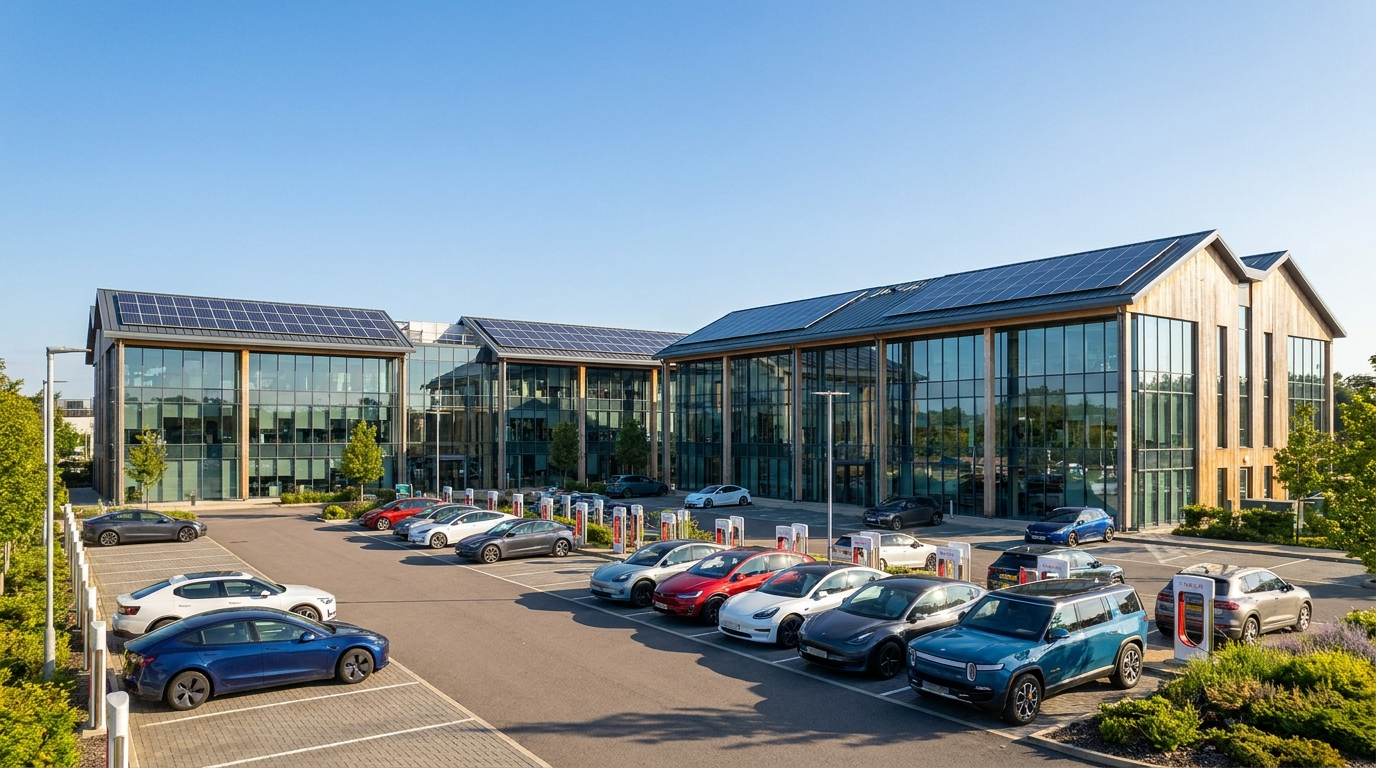
Greenwashing your CSR report with one rapid charger? Your customers can smell it.
One rapid charger on the front page of an annual report contributes 0.2% to your Scope 1 emissions reduction. Your customers' procurement teams have spreadsheets. They can see this.
A single 50kW rapid charger on a UK corporate site, used at typical commercial utilisation, abates roughly 3.2 tonnes of CO2e per year versus the equivalent diesel driving. A mid-sized UK law firm — call it 480 staff and an 80-vehicle salary-sacrifice fleet — emits around 1,600 tonnes CO2e annually across Scope 1 and 2. The rapid charger contributes 0.2% of the firm's emissions reduction. That's the number. That's what your photo op is doing.
The villain in this post is the single-rapid-charger virtue signal on the front page of an annual report. You've seen it. A CEO in a hard hat next to a shiny new unit, "demonstrating our commitment to sustainability." The unit will be used 8 times a week by the marketing director's Polestar. Your customers' procurement teams — Tesco, Unilever, NHS supply chains, increasingly every large enterprise filtering tenders for carbon disclosure — will read that page and quietly move you to the "performative" pile.
This isn't about virtue. It's about the fact that UK corporate carbon disclosure is now legally mandatory under SECR (Streamlined Energy and Carbon Reporting) for any company over 250 staff, £36m turnover or £18m balance sheet, and CSRD (the EU Corporate Sustainability Reporting Directive) is now spilling onto UK subsidiaries of EU parents. Your B2B customers are pre-filtering suppliers by carbon disclosure quality. One rapid charger doesn't get you through that filter. It gets you actively excluded from it.
The credibility hierarchy
There are five tiers of corporate EV strategy in the UK in 2026. Where you sit decides whether your CSR report gets read or quietly skipped.
Tier 1 — The Photo Op. One rapid charger, prominently photographed. 0.2% Scope 1 reduction. Contributes essentially nothing to your SECR disclosure. Actively damages credibility with procurement teams who recognise the pattern. Cost to install: £35,000. Cost to your B2B reputation: hard to quantify, but real.
Tier 2 — The Token Workplace Estate. 6–10 workplace chargers, available to staff with EVs, no fleet strategy behind it. Solid, but small. Maybe 4–6% Scope 1 reduction. Helps recruitment. Doesn't move the SECR needle materially.
Tier 3 — The Fleet Electrification. All company vehicles transitioned to EVs over 3–5 years. This is where the maths starts to work. A typical 80-car salary-sacrifice fleet running on diesel emits roughly 240 tCO2e per year. Moving 90% of that to BEV by 2030 abates 210 tCO2e/year by 2030 — about 13% of total firm emissions for the law firm above. Credible, audit-defensible, aligned with SBTi (Science Based Targets initiative) common corporate commitments of 50% reduction by 2030.
Tier 4 — The Full Stack. Fleet electrification PLUS commercial solar PV PLUS battery storage PLUS smart energy procurement. This is where credibility lives. You're not just decarbonising your transport; you're decarbonising your energy generation and consumption simultaneously. Scope 1 + 2 reductions of 30–45% are achievable on a 3-year horizon for typical office-led businesses.
Tier 5 — The Embedded Strategy. Tier 4 PLUS supply chain Scope 3 reporting, customer-side ESG integration, governance at board level. The handful of UK corporates that have actually done this are the ones winning Tesco supply chain tenders that the rest of you are losing.
Most UK corporates are still at Tier 1 or 2. The procurement teams filtering your tenders are looking for Tier 3 minimum. The best-in-class are already at Tier 4.
Free download
Warehouse Energy Stack — 5-yr P&L
40,000 sq ft logistics + 25-van fleet: solar + battery + EV chargers as one integrated system.
What your customers' procurement teams actually filter for
This is the bit that makes most ESG strategists uncomfortable. Carbon disclosure is no longer a reporting exercise. It's a sales filter.
NHS supply chain procurement now formally weights carbon disclosure quality at 10% of evaluation criteria on contracts above £5m. Tesco's supplier sustainability programme requires Scope 1, 2 and material Scope 3 reporting from all Tier-1 suppliers. Unilever's Climate Transition Action Plan mandates SBTi alignment from key suppliers by 2027. The pattern is identical across most FTSE-100 enterprise procurement.
Your customers' procurement teams aren't reading your CSR report cover to cover. They're filtering on three data points:
- SECR disclosure quality — are your Scope 1 and 2 numbers complete, audited, and trending in the right direction?
- Science Based Targets alignment — have you committed, and are you on track?
- Material Scope 3 categories — particularly Category 4 (upstream transport) and Category 6 (business travel) — are you measuring them?
One rapid charger doesn't appear in any of those three filters. A full-stack energy strategy does, and it does it credibly because the numbers add up.
The worked example: 480-staff London law firm
This is anonymised but real. Numbers are from the firm's actual SECR baseline and a 3-year full-stack programme we delivered.
Baseline (2023):
- Total Scope 1 + 2 emissions: 1,610 tCO2e/year
- Fleet emissions (80 cars, mostly diesel): 245 tCO2e/year
- Building energy (one central London office, gas heat, grid electricity): 640 tCO2e/year
- Other Scope 1+2: 725 tCO2e/year
The "we installed a charger" approach (Tier 1):
- 1 × 50kW rapid charger at £35,000 capex
- 3.2 tCO2e/year abated
- 0.2% Scope 1 reduction
- SECR disclosure unchanged
- Outcome: still failing the customer procurement filter
The full-stack approach (Tier 4) over 3 years:
- 90% fleet to BEV by year 3 (72 of 80 cars, salary sacrifice transition): £0 direct capex to firm; firm provides workplace charging infrastructure
- Workplace charging: 16 × 22kW twin AC at average £5,000 installed = £80,000, minus Workplace Charging Scheme grant (32 sockets × £500 capped) = £64,000 net
- 320kWp solar carport over staff parking: £420,000 capex, generating ~280,000 kWh/year, abating 58 tCO2e/year versus grid average
- 200kWh battery storage for solar firming and demand response: £140,000
- Smart energy plan (half-hourly settlement, dynamic tariff, PPA on residual): £0 capex, ~£64,000/year operational saving
Total capex: ~£680,000 across 3 years.
Annual benefits:
- Fleet emissions abated: 210 tCO2e/year (90% of fleet × 245 tCO2e baseline ratio)
- Solar generation displacing grid: 58 tCO2e/year
- Battery and smart tariff: marginal direct emissions, £64,000/year opex saving
- Workplace charging energy revenue/savings: £12,000/year net
- Capital allowance and full-expensing relief on £680k qualifying spend at 25% CT: ~£170,000 tax saving over 3 years
- Annualised opex saving: £210,000/year. Total Scope 1+2 reduction: 38%.
That's audit-defensible. That's SBTi-aligned. That gets you through the Tesco supplier filter. The single rapid charger doesn't.
Payback on £680k of net capex (after grants and tax relief, roughly £490k effective): ~2.3 years on opex alone, ignoring the commercial value of clearing the procurement filter — which is where the real money lives.
The policies your ESG team should be writing
If your sustainability lead is on the phone reading this paragraph aloud to your CFO, here are the four things they should be writing into governance documents this quarter.
1. SBTi commitment with a 2030 milestone. Public, board-approved, with quarterly reporting against the trajectory. Without this, your SECR disclosure is just a number with no destination.
2. Fleet electrification policy with named milestone years. No new diesel orders after a date. Salary sacrifice BEV cap-removal. Pool car policy explicitly preferring BEV. Procurement scoring weight on supplier fleet emissions for any sub-supplier above £500k spend.
3. Capital programme alignment. Solar PV, battery storage, EV charging, smart energy procurement and building electrification grouped into a single 3-year capital programme with one named owner. Not five separate procurement exercises.
4. Customer-facing disclosure quality. SECR data audited to ISAE 3000 standard. SBTi progress published in interim and annual reports. Scope 3 categories 4 and 6 measured even if not yet reduced. This is what your customers' procurement teams pull off your website before they call you.
If those four policies exist, your CSR report doesn't need a hard hat photo. The numbers do the work.
What to ask before you sign anything
- "What's our SECR baseline by Scope 1, 2 and material Scope 3 categories — and is it audited?"
- "Have we committed to SBTi, and what's our trajectory to 2030?"
- "What's our total Scope 1+2 reduction percentage from the proposed capital programme — not the headline, the audited number?"
- "What's the payback on the full stack against opex savings, capital allowances, and grant funding combined?"
- "Which of our top-10 B2B customers explicitly require supplier carbon disclosure, and where do we currently rank?"
Five questions for your ESG team, finance team, and procurement team to answer together. If they can't, the photo op is the least of your problems.
The short version
One rapid charger contributes 0.2% to your Scope 1 reduction. UK SECR and CSRD spillover make audited disclosure mandatory above 250 staff or £36m turnover. SBTi alignment is now the procurement filter Tesco, Unilever and NHS supply chains use to pre-screen suppliers. Tier 1 (the photo op) gets you excluded. Tier 3 (fleet electrification) clears the filter. Tier 4 (full stack — solar, battery, EV, smart energy) delivers 30–45% Scope 1+2 reductions with ~2.3 year paybacks on opex savings before counting the commercial upside of being a supplier procurement teams actually shortlist. The numbers do the work. The hard hat doesn't.
Want us to do the maths on your site?
Talk to our team at /contact. We'll model your SECR baseline, map the full-stack capex against grants and capital allowances, and tell you straight whether you're at Tier 1, 2, 3 or 4 today. Then we'll show you exactly what it costs to move up two tiers in 36 months. The procurement filter doesn't care about hard hats.
Energy Partners
Energy Partners — commercial energy specialists for UK businesses.