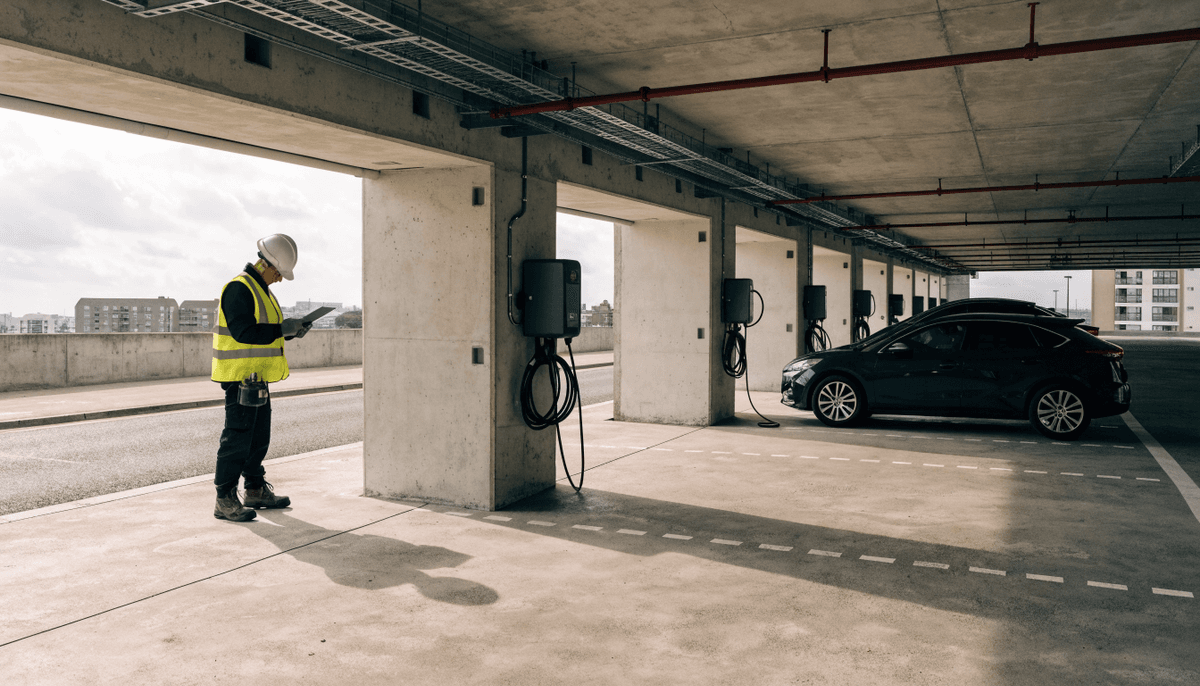
If you're designing a new office, retail scheme, hospital or apartment block with a multi-storey or basement car park in England, you've had a quiet get-out on EV charging for four years. Under Part S of the Building Regulations, spaces under a roof have only needed cable routes: empty ducting for a charger someone might fit later. Not working chargers.
On 21 October 2026 the Department for Transport and the Ministry of Housing, Communities and Local Government opened a consultation to close that gap. It proposes that new and major-renovation covered car parks, both enclosed and open-sided, must have charge points installed like any other building. It closes at 11:59pm on 16 December 2026.
Nothing has changed in law yet. But if your project is at RIBA Stage 2 or 3 now, it may well reach site after the rules have moved. Here's what's on the table, what it actually costs you, and what to do before Christmas.
What Part S requires today
Part S came into force on 15 June 2022 and applies in England. The headline rules:
- New non-residential buildings with more than 10 parking spaces: at least one charge point, plus cable routes for one in five of the total spaces.
- Non-residential major renovations that will have more than 10 spaces afterwards: the same, one charge point and cable routes for one in five. A "major renovation" means work on more than 25% of the building envelope's surface area. If the EV work would cost more than 7% of the renovation, you can fit cable routes only.
- New homes with a parking space: a charge point for every dwelling that has one.
- Every charge point: at least 7kW, on a dedicated circuit, and compliant with the Smart Charge Points Regulations.
- Covered spaces: the "precautionary approach". Charge points go in uncovered spaces first. Where the parking is under a roof, you can meet the requirement with cable routes instead.
That last point is the loophole. A city-centre office whose only parking is a basement deck can comply today without a single working charger in it. So can a new block of flats with undercroft parking. The reason was fire safety: government wanted more research on EVs in enclosed spaces before forcing chargers into them.
What's proposed
The consultation document sets out five main changes:
- Covered car parks brought into line. Charge point requirements would apply to enclosed and open-sided covered car parks in new buildings and major renovations. Existing car parks would not have to be retrofitted.
- The £3,600 cost cap reviewed. Part S lets residential developers stop fitting charge points once the average grid connection cost goes above £3,600 per point, and use cable routes for the rest. That figure dates from 2021. Government is asking whether it should rise, and whether it should go up each year with CPI. No new figure has been proposed.
- Minimum charger standards. Possible requirements for load management and PEN fault protection, plus wiring standards and voltage drop.
- Clearer definitions of "major renovation" and "cable route", which have caused arguments between developers and building control since 2022.
- Vehicle-to-grid. Not mandated, but government wants views on what infrastructure new buildings will need over the next 5 to 10 years. It's also asking whether tethered chargers should be allowed, not just socketed ones.
A second consultation, published the same day with the same closing date, deals with tenants and leaseholders. It tests whether landlords and freeholders should be legally required to decide on a resident's charge point request within a reasonable time and not refuse unreasonably. A 28-calendar-day response period is suggested. Residents would pay to install. Who pays for maintenance and removal is still open. It covers allocated, demised and communal parking, including flats and mixed-tenure schemes.
The honest bit: the legal minimum is tiny
For a commercial building, bringing covered car parks into line mostly means one working charger, plus ducting for 20% of spaces. A 400-space multi-storey office car park would need one 7kW charger and 80 cable routes to comply.
One charger in a 400-space car park is a compliance tick. It isn't a charging offer. So the real effect of this consultation on commercial sites isn't the minimum. It's three knock-on effects:
- Fire strategies will have to plan for charging under a roof. Once working chargers in covered decks become the norm, your fire engineer, insurer and building control will all expect the design to deal with them from day one. That's cheaper to settle at design stage than after handover.
- Electrical capacity gets decided at design stage. Cable routes are cheap. The supply behind them isn't. If your connection is sized for lighting and lifts, the 80 future chargers your ducting promises may never get power. Our guide to DNO applications explains why that quote can take months.
- Residential and mixed-use schemes are hit hardest. In a new apartment block, "a charge point for every dwelling with a space" applied to a basement car park is a big step up from ducting. Expect that to show up in cost plans and in viability arguments over the £3,600 cap.
The fire question
This is the reason covered car parks were left out in 2021, so it's the part of the consultation worth reading most carefully. Government published interim guidance on EVs in covered car parks in 2023, based on Arup research, and is now asking for feedback on it.
Keep one fact in mind when someone in a design meeting blames EVs. The fire that destroyed Luton Airport's Terminal Car Park 2 on 10 October 2023 started in a diesel car. Bedfordshire Fire and Rescue Service's review says it was neither an EV nor a plug-in hybrid, and the most likely cause was an electrical fault in the engine bay. The same review says a suitable sprinkler system might have changed how the fire spread.
So the useful conversation isn't "EVs or no EVs". It's whether the car park is built to contain a vehicle fire of any kind: sprinklers, ventilation, compartmentation, and where the chargers and isolators sit relative to escape routes and fire service access. That's what your fire engineer should be asked to cover, and it's where the consultation wants evidence.
What to do before 16 December
1. Check where your project sits in the timeline. Part S applies based on when plans are deposited and work starts. If you're early in design, assume the covered car park rule will apply and design for it now. Changing ducting to working chargers later costs more than doing it once.
2. Size the supply for the car park you'll actually need. Start from how many users will want to charge: staff, visitors, residents, fleet. Don't start from the Part S minimum. If you'll eventually power 20% of spaces, ask for that capacity in the connection application now, or design for load management so a smaller supply can serve more chargers.
3. Brief your fire engineer specifically on charging. Ask for charger locations, isolation, ventilation and sprinkler provision in covered decks to be part of the fire strategy, with the 2023 interim guidance as the starting point.
4. Specify chargers that will meet the likely standards. Load management and PEN fault protection are already good practice. Build them into the spec and you won't be redesigning if they become mandatory.
5. If you're a landlord or freeholder, write your process now. If the 28-day "ability to charge" proposal goes through, you'll need a standard way to assess requests, approve installers and agree who maintains what. Our installer checklist is a good basis for approving residents' contractors.
6. Respond to the consultation. If you build, own or manage covered car parks, you're exactly who it's asking. The £3,600 cap question in particular will decide how many residential schemes end up with chargers rather than ducting.
Our take
The planning side has moved fast this year. Since 21 October, larger charging hubs can go into existing car parks under permitted development. The building regulations side is now catching up for new buildings. As ChargePoint's John Saffrett put it when the changes were announced, "planning reform alone won't deliver the charging network businesses need". Grid capacity and good design still decide whether a car park actually charges anything.
The minimum Part S asks for is small. The cost of designing a covered car park that can't take chargers later is not. If you're building one in the next two years, plan for working chargers now and treat the consultation as a deadline, not a debate.
For what the hardware and connection will cost once you get there, see what a commercial EV charger actually costs in 2026.
Designing or refurbishing a covered car park?
We'll look at your drawings or your existing site, tell you what Part S requires now and what the consultation would add, size the electrical supply for the charging you'll actually need, and flag the fire and capacity questions to settle early. No obligation.
Site SurveyRead this article in the app at energy-partners.co.uk/insights/covered-car-park-ev-charging-part-s-consultation-2026. Energy Partners installs and manages commercial EV charging, solar and battery storage for UK venues — talk to us.