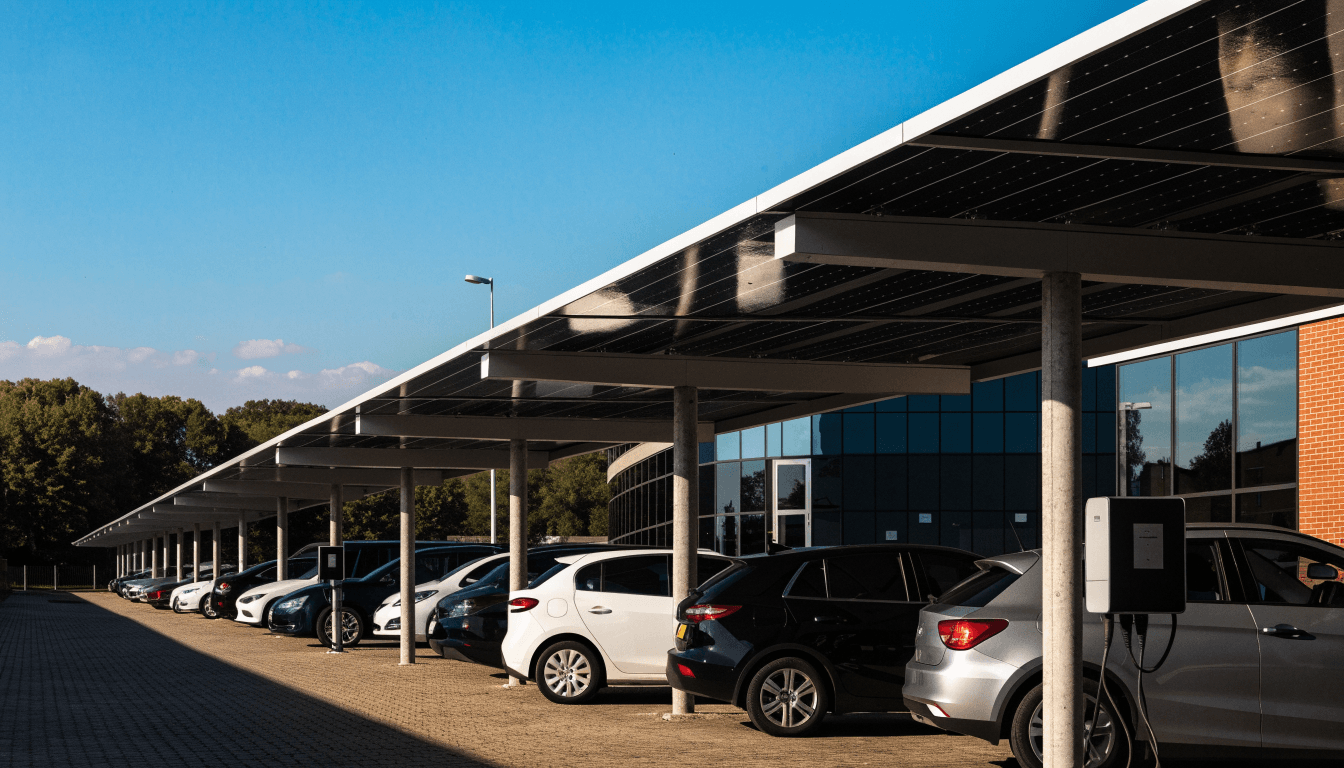
A 200-bay retail park in the South-East has about 4,800 square metres of empty sky above its asphalt. That sky receives, on a UK annual average, 1,000-1,150 kWh of solar radiation per square metre. The car park covers four rows. If you canopied them, you'd install around 450kWp of solar PV, generate 400,000 kWh a year, shelter your customers from British weather, give your staff a place to walk to a dry car, and build the structural skeleton for the EV chargers you'll need by 2028. You'd also bank around £67,000 a year in displaced electricity costs and another £24,000 in charger revenue. Payback comes in around five years. Capex around £540k for the solar, £75k for the chargers.
The villain is your car park. It earns nothing. It does nothing. It sits there in the rain costing you in rates, maintenance, line-marking and resurfacing while exposing your customers to weather that makes them shop quicker and spend less. A solar carport turns that liability into three assets at once. The reason almost nobody's done it is a cost objection that used to be valid in 2018 and isn't any more.
Why nobody's done it (the objection that's now wrong)
The standard objection in the boardroom goes: "Solar canopies cost twice as much per kWp as a rooftop install." That used to be true. In 2018, canopy structures pushed installed costs to £1,600-£2,000/kWp against rooftop at £700-£900/kWp. The structural steel was the issue.
In 2026, commercial-scale solar carport installs come in at £1,100-£1,400/kWp, against rooftop at £750-£950/kWp. The gap has closed, mainly because:
- Standardised steel canopy systems from European manufacturers (Schletter, Solarwatt structures, K2) now ship in modular bays.
- Higher-output panels (450-550W) mean fewer panels per kWp, which means lighter structures.
- The same canopy that holds your solar can be specified with EV charger conduit cast into the columns — saving you the trenching cost when you add chargers in year two.
So yes, it's still 30-40% more expensive per kWp than a rooftop install. But the rooftop install doesn't shelter customers, doesn't pre-wire your EV chargers, and doesn't transform an unloved asphalt asset into a customer-experience improvement. The comparison isn't fair.
What you actually get per row
A typical UK car park row covers 50 bays in two facing rows of 25 (back-to-back parking). Canopying one full row gives you:
- Footprint: ~600m² of canopy
- Solar capacity: 40-80kWp (panel density, orientation and structural choices flex this)
- Annual generation: 35,000-72,000 kWh
- Self-consumption value (if 60% used on-site at 27p/kWh): £5,700-£11,700 a year per row
A four-row install — typical for a mid-sized retail park, a stadium overflow lot, an industrial estate visitor block or a hospital staff park — gives you 160-320kWp and 140,000-288,000 kWh a year.
Planning permission: the bit that scares people
This is where the project either goes smoothly or stops dead at week eight. Three routes:
Class A permitted development (PD). Most commercial solar carports under 4m height, on non-listed buildings, outside conservation areas, qualify as permitted development under Schedule 2, Part 14 of the Town and Country Planning (General Permitted Development) (England) Order 2015 (as amended in 2023 to expand non-domestic solar PD rights). Prior approval may be required for visual impact — typically an eight-week process, much faster than full planning.
Full planning permission. Required if your canopy exceeds 4m, sits in a conservation area or AONB, or you're a listed building neighbour. Budget 8-13 weeks for determination, plus pre-app consultation. Worth it for the larger schemes; the planning officers we've worked with are broadly positive on solar canopies as long as the structural design isn't ugly.
Permitted development with prior approval (mixed). A useful middle path for larger installs that technically exceed PD limits but are unobjectionable in form. Discuss with the planning department in week one.
The thing nobody tells you: Building Regs Part A (structural) and Part L (energy efficiency reporting) still apply. Budget structural engineer fees of £4,000-£9,000 for a four-row install. Worth it.
A worked example
Site: 200-bay retail park, Southeast England, single-occupier anchor + four sub-tenants, 800kVA supply with 25% headroom, current annual electricity spend ~£185,000.
Solution: Solar canopies over four rows (200 bays covered), 450kWp installed capacity, 12 destination EV charging sockets integrated into canopy columns (6 × 22kW twin units).
Capex:
- Solar canopy structures + 450kWp PV + inverters + commissioning: £540,000
- 12 × 22kW twin sockets, comms, payment terminals, integration: £75,000
- Planning, structural, building regs, civils: £35,000
- Gross capex: £650,000
Grants and tax:
- Workplace Charging Scheme not applicable (public-facing); use FYA across the lot
- FYA at 25% CT on £650,000 capex: ~£162,500 tax saving
- Net capex: ~£487,500
Year one annual stack:
- Solar generation 400,000 kWh; 60% self-consumed at displaced 27p/kWh: £64,800
- Surplus 40% exported at 8p/kWh SEG (Smart Export Guarantee): £12,800
- EV charging revenue, 12 sockets at modest utilisation (3.5 sessions/day average, £4.20 margin per session): £22,000
- Dwell-time uplift on shelter — modelled at 4% basket size increase across covered bays (validated by industry studies on covered retail parking): £18,000
- Total year-one annual: ~£117,600
Payback (gross): 5.5 years Payback (net of FYA): 4.1 years 25-year cumulative cash (with 0.5% annual degradation, modest inflation on retail electricity prices): ~£3.1m
That's a fully-amortised asset by year six. Years seven through twenty-five are nearly free generation on infrastructure you've already paid for.
Integration with EV chargers — get the spec right in week one
The single biggest mistake on canopy projects is treating the EV chargers as a year-two retrofit. They aren't. You make the structural decisions in week one. Demand the following:
- Charger conduit pre-installed in canopy columns. Two 50mm ducts minimum per column. Adds maybe £80 per column. Saves £600+ per future charger.
- Sub-board sized for future load. If you're installing 12 sockets now, size the distribution board for 24. A panel upgrade in year three costs five times what the headroom premium does now.
- Structural rating for higher-power chargers. Today's 22kW AC chargers weigh 30kg. Tomorrow's 50kW DC chargers weigh 180kg. Spec the columns accordingly.
- Cable management at canopy underside. Tidy cable trays make future charger additions a half-day job, not a three-week civils project.
What to put in the structural spec
- Snow loading appropriate for postcode (specifically: Snow Load Maps under BS EN 1991-1-3).
- Wind loading per BS EN 1991-1-4 for the site exposure category.
- Glazed roof (panels) rated for non-fragile loading — Class B minimum, Class C preferred — to allow safe maintenance access without scaffolding.
- Galvanised steel to ISO 1461, plus optional powder-coat for visual environments.
- Solar inverter location specified at design stage — string inverters at column base or central inverter room behind canopy; don't leave it to the contractor.
- EV charger socket allocation per bay defined at structural design stage, with conduit and column-mount points sized accordingly.
The short version
Solar carports in 2026 install at £1,100-£1,400/kWp at commercial scale. A 450kWp system on a 200-bay retail park generates ~400,000 kWh/year, displaces ~£65,000 of grid imports, earns another ~£13,000 on SEG export, supports 12 EV charging sockets earning ~£22,000/year, and lifts dwell-time-driven basket size by ~£18,000. Total annual ~£117,000 against net capex of ~£487,500 post-FYA. Payback 4-5 years. Twenty-year cumulative cash north of £3m. Permitted development covers most schemes; budget structural engineer fees properly. And whatever you do, pre-wire for chargers at week one.
Want us to do the maths on your site?
Book a site survey at /site-survey. We'll model your specific car park layout, generation yield against your postcode-specific irradiance, the integrated charger revenue, and the structural envelope your planning officer will actually approve. Including the bit about pre-wiring conduit in the columns. (Especially that bit, because nobody else mentions it.)
Site SurveyRead this article in the app at energy-partners.co.uk/insights/solar-carport-uk-commercial. Energy Partners installs and manages commercial EV charging, solar and battery storage for UK venues — talk to us.