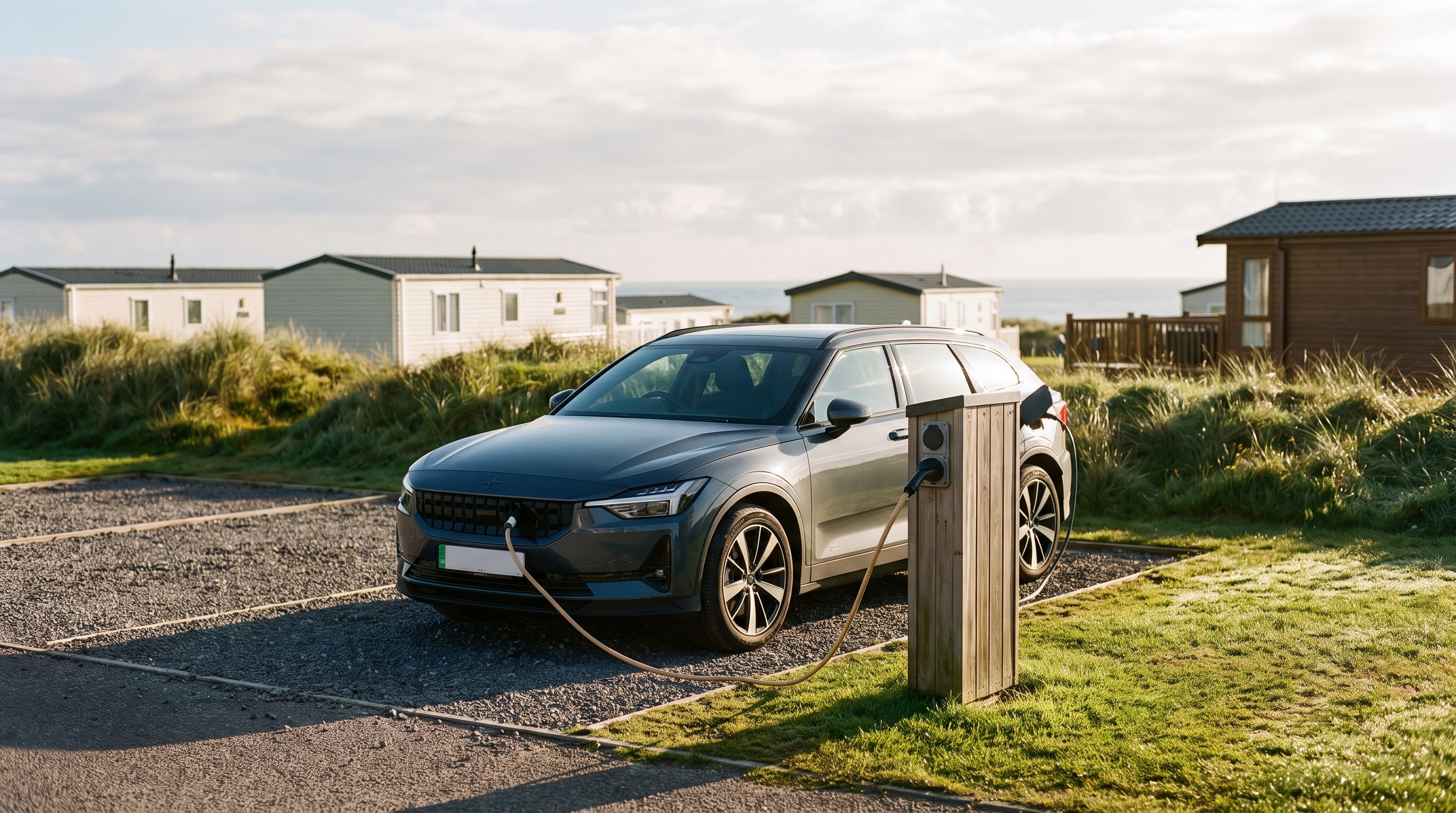
UK holiday parks and campsites generate £12.2 billion a year in visitor spending, support 226,745 full-time jobs, and their guests spend just over £100 a day while staying 82% longer than the national tourism average — the UK Caravan and Camping Alliance's own economic report says so. Meanwhile the UK passed 2 million EVs this year. Put those two facts in the same car park and something obvious falls out: the longest dwell time in British destination charging is sitting on gravel, earning nothing.
We've made the dwell-time argument before — 45 minutes at a supermarket, four hours at a golf club. Holiday parks don't measure dwell in hours. They measure it in nights. A guest who parks up on Saturday doesn't move the car until the fish-and-chip run on Tuesday. A 7kW socket doesn't need to be fast in that window; it needs to exist.
Your guests arrive flat, in the middle of nowhere
Here's the bit the sector hasn't priced in. Holiday parks are, by design, where the charging network isn't. DfT's July 2026 statistics counted 121,171 public charge points with a badly lopsided map — dense in London and the cities, thin along exactly the rural and coastal territory where parks trade. Your guest drives 150–250 miles to reach you, arrives with 15% battery, opens a charging app and finds the nearest rapid is a 20-minute drive back to the market town they just passed. That's the first hour of their holiday.
And because drivers are resourceful, the sector already has an EV charging problem — just an unmanaged one. Guests quietly plug granny leads into 16-amp pitch hook-up bollards that were specified for a kettle, a fridge and a TV, not eight hours of continuous car charging. Parks have responded, reasonably, by banning it. But a ban with no alternative is the worst of both worlds: you've told your highest-spending, fastest-growing guest segment that their car is their problem, on a site where the public network can't catch them either.
What the numbers look like for a park
Be conservative. Two dual-socket 7kW pedestals near reception — four sockets. Assume just three sessions a day across all four, averaging 30kWh each, at a margin of around 20p per kWh between your commercial rate and a fair guest tariff. Over a 210-day season that's roughly £3,800 in gross margin — from an asset that needed no staff and no floor space.
The second-order revenue is the bigger story, same as every hospitality destination site reports:
- The booking filter. EV drivers now filter for chargers the way families filter for a pool. Working sockets, listed on the charging apps, put your park in front of a growing guest segment at zero marketing cost — and keep the 2-million-and-counting EV owners from booking the park down the coast that has them.
- Longer, later seasons. The £100-a-day figure compounds: guests who can charge on site don't cut a shoulder-season break short because the range maths got nervous in November.
- The hook-up truce. A proper charging bay ends the granny-lead argument at check-in. Your pitch bollards go back to running kettles, your insurance stays uncomplicated, and nobody's warden is policing extension cables at 11pm.
The grant that names you
The Workplace Charging Scheme covers 75% of purchase and installation up to £500 per socket, across up to 40 sockets — and its eligibility list doesn't just cover businesses and charities, it explicitly names small accommodation businesses. That category exists precisely so that guest-facing sites like parks, B&Bs and holiday lets can claim; the current £500 rate took effect on 1 April 2026. On our four-socket example that's £2,000 off before you've negotiated anything; a larger park wiring a full bay could claim up to £20,000. The wider funding picture is in our 2026 grants round-up.
One date matters more than the rest: the scheme closes to applications on 31 March 2027. Most parks shut or wind down from November to March — which makes the coming closed season the last one where you can do the civils with no guests on site and have the government pay a quarter of the bill. Install in the winter of 2027–28 and you'll do the same work at full price.
Where parks get it wrong
Buying rapid chargers. A 50kW rapid is the wrong tool for a seven-night dwell, exactly as it is for a four-hour golf round: multiples more to install, often triggers a grid-connection upgrade, and finishes three days before the guest does. For parks, 7kW AC is right-sized — cheap hardware, cheap civils, and the calendar does the work.
Assuming the supply can take it. Parks run pools, arcades, laundries, restaurants and hundreds of pitch hook-ups, frequently at the end of a long rural feed that was specified decades ago. Load management usually avoids a costly DNO application — but that's a survey finding, not a guess.
Free vend forever. Free charging feels like hospitality and quietly becomes a four-figure electricity subsidy as EV numbers grow. Set a fair guest tariff from day one. Guests accept paying for fuel; what they won't accept is four sockets permanently occupied because they're free.
Closed systems. Buy hardware that speaks OCPP, the open protocol, so you can change management platforms without ripping out kit. Vendor lock-in hurts seasonal businesses most — you find out about the subscription hike in March, a fortnight before opening.
The competitive clock
Parks compete on reviews and repeat bookings more than almost any venue type in Britain — the whole model is families coming back to the same pitch every year. The first park in a bay with visible, working, fairly priced chargers gets a differentiator its neighbours have to answer. The third park to install gets parity, at next winter's prices, probably without the grant.
What to do before the season ends
Get the supply assessed while guests are still on site and the office has time to think. A proper site survey tells you what your connection can support, whether load management avoids a DNO application, what the cable runs to the car park actually cost, and what a phased install looks like — two sockets now, ducting for eight — so you buy once, over the winter, with the grant.
We survey holiday parks, campsites and leisure sites across the UK, handle the Workplace Charging Scheme paperwork, and only recommend open-protocol hardware. Book a site survey and open for the 2027 season with a car park that finally earns its keep.
Site SurveyRead this article in the app at energy-partners.co.uk/insights/ev-charging-holiday-parks-campsites-uk. Energy Partners installs and manages commercial EV charging, solar and battery storage for UK venues — talk to us.