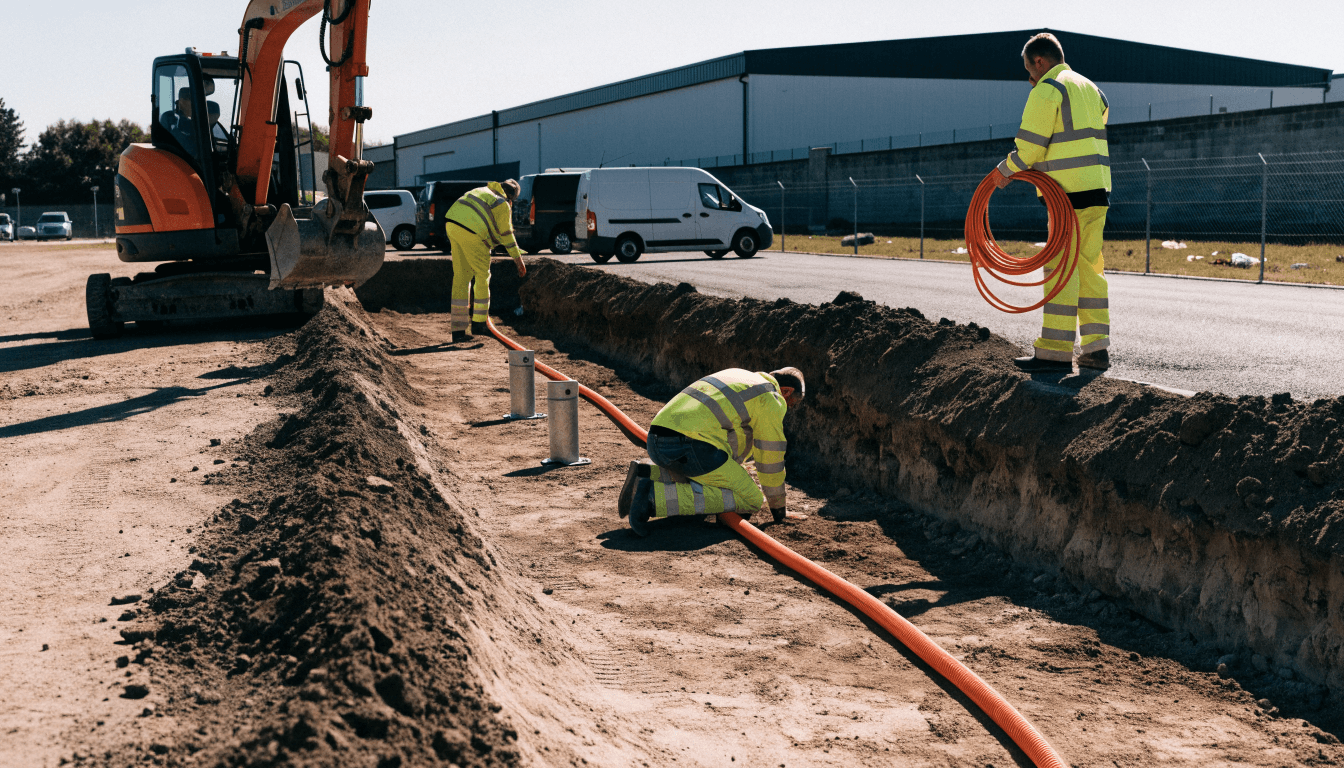
A real 4-week UK depot EV install is possible. It requires: DNO application submitted on day 1, no grid reinforcement needed, civils under 40 metres, switchgear and hardware in stock. About 30% of UK commercial installs hit this, in our experience across 200+ commercial sites delivered. 50% complete in 6–10 weeks with light DNO work or moderate civils. 20% take 12 weeks or longer when grid reinforcement is required and G99 applications go into the 65-day window. Genuine 8-socket installs at a real Midlands logistics depot have completed in 27 days start to energisation. Others have stretched to 84 days because the DNO came back asking for a £180,000 transformer upgrade nobody pre-quoted.
The villain of this post is the salesman who quotes "4 weeks" on the call, signs you, then disappears at the DNO application stage and reappears at week 9 to explain that the grid won't take what you ordered. He's not lying, exactly. He's just selling the median outcome from the lucky bucket as the headline number from his pitch deck. We'll explain what the timeline actually looks like, what the three milestones nobody distinguishes are, and what to put in your contract so "4 weeks" means something.
The realistic timeline distribution
Across the 200+ commercial sites we've delivered, the timeline outcomes break down roughly:
- ~30% complete in 4 weeks. Single-phase or simple three-phase upgrade. G98 application (under 16A per phase or under the local DNO simplified threshold). Civils under 40m. Hardware on shelf. The site already has spare capacity at the supply.
- ~50% complete in 6–10 weeks. G99 application required, but no reinforcement quoted by the DNO. Civils 40–120m. Possibly a switchgear upgrade. Hardware on a 2–4 week lead time.
- ~20% complete in 12+ weeks. G99 with reinforcement. Transformer upgrade. Wayleave required across third-party land. Specialist hardware on long lead. DNO response uses the full statutory window.
The 30% is real. We hit it routinely. But the only way to know which bucket your site is in is to do the survey, submit the DNO application, and look at the answer. Anyone promising you 4 weeks before they've done that is making a guess in your favour to close the sale.
The DNO application — the bit that owns the critical path
The Distribution Network Operator is your regional grid operator (UKPN, NGED, SP Energy Networks, SSEN, Northern Powergrid, Electricity North West). Their job is to decide whether your local network can accept what you want to install without destabilising it. The application is either:
- G98 (Engineering Recommendation G98) — for small-scale installations connecting to single-phase or low three-phase loads. Typically a 28-day notify-and-connect process.
- G99 (Engineering Recommendation G99) — for larger connections. Statutory response window of 11–65 working days depending on the connection size and the DNO's queue. Most commercial depot EV installs fall here.
The DNO application is owned by the installer. The clock starts when the application is complete and accepted — not when you signed the contract, not when the survey was done. Every week of paperwork delay is a week off your 4-week timeline. Reputable installers submit on the day of the site survey if the design is clear.
If the DNO comes back asking for reinforcement (transformer upsize, new feeder cable, switchgear replacement), that's an additional 6–20 weeks of grid work, costed separately, often with shared-cost contributions from the DNO depending on capacity headroom rules. This is where 4-week timelines die.
The three milestones the salesman won't define
The biggest source of week-9 customer rage is that the salesman, the installer and the customer are all using the word "done" to mean three different things. Pin these down in writing before you sign.
Commissioning. The chargers are physically installed, wired, mechanically and electrically tested, configured against the back-office software, and able to deliver a charge under controlled conditions. Commissioning does not mean the unit is on the public grid yet — sometimes it's running off a temporary supply or a build supply.
Energisation. The DNO has approved the connection, the meter has been fitted by the MOP (Meter Operator), and the chargers are receiving permanent supply at full design capacity. This is the moment the asset can actually do its job.
Sign-off. All certificates issued (NICEIC/NAPIT installation certificate, manufacturer's commissioning certificate, IET wiring regs compliance, EVCP certification under BS 7671). Handover pack delivered. SLA clock starts. Warranty engaged.
If the contract says "4-week install" without distinguishing these three, you're going to argue about it. We've seen sites "delivered" against contract on day 28 in the sense of commissioned, but not energised until day 51 because nobody chased the DNO and MOP coordination. The site cannot charge a vehicle for the in-between three weeks.
Put each milestone in the contract with its own date, its own deliverable list, and its own liquidated-damages exposure if missed.
A worked example — real 4-week 8-socket depot install
Site: Logistics operator, Midlands, 35-van depot. Brief: 8 × 22kW twin-socket workplace AC chargers (16 sockets total), depot return-to-base overnight charging. Existing three-phase supply with spare capacity confirmed by initial desktop review.
Week 1:
- Monday: site survey, electrical assessment, civils route walked, hardware specification confirmed.
- Tuesday: DNO G99 application submitted (under-threshold for full reinforcement); hardware reserved with distributor; commissioning slot booked.
- Wednesday: civils contractor briefed, materials ordered for delivery Friday.
- Thursday–Friday: detailed design issued; client signs off on bay layout and signage.
Week 2:
- Civils gang on site Monday. 32m trench, ducting, four concrete bases. Complete by Wednesday.
- DNO G99 approval received Thursday — within the simplified G99 window (well under 65 working days).
- Switchgear and dedicated feeder cable arrive Friday. Installation by depot electrician begins.
Week 3:
- Hardware on site Monday. Eight units mounted, wired, comms commissioned, back-office integrated against the depot's OCPP platform Tuesday–Wednesday.
- NICEIC inspection and certification Thursday.
- MOP attends Friday for meter fit.
Week 4:
- Monday: full-load testing under controlled conditions (commissioning milestone).
- Tuesday: DNO confirms energisation, permanent supply live.
- Wednesday: full energisation milestone. Chargers active under SLA.
- Thursday–Friday: handover pack, driver training, sign-off milestone. SLA clock starts. Warranty engaged.
Day 28: energised, signed off, charging vans.
The variant when DNO bumps it to 7 weeks: the same plan, but the DNO comes back at end-of-week-2 asking for an upstream switchgear stiffening (not full reinforcement, just a switchgear swap at the supply intake) costing an additional £14,000 and adding 3 weeks of lead time on the switchgear part. Site still energises at day 49. Still on the fast end of the realistic curve.
What to put in your contract
Most install contracts are written by the installer's commercial team and signed by the customer's procurement team without anyone in operations reading them. Get these clauses in:
- Three named milestones, each with its own delivery date: commissioning, energisation, sign-off.
- Liquidated damages at each milestone if breached without DNO-attributable cause (and a clear definition of what counts as DNO-attributable).
- DNO application timing — installer commits to submit within X working days of site survey, with the application bundle as a contractual deliverable.
- Hardware reservation — units must be reserved and dated against the project, not pulled from the next-customer-pays bin if a higher-paying job lands.
- OCPP open-protocol guarantee — units must be open-protocol from day one, so you can change back-office provider without changing hardware.
- Warranty length and assignment — minimum 5 years, with a clause covering installer insolvency (warranty assigns through to the manufacturer).
- Uptime SLA — 99% minimum, with credits payable if breached. Not "monitoring" — credits.
- MOP coordination owned by the installer — meter fitting is the single most-forgotten step in a 4-week project. Make it the installer's job.
What to ask before you sign
- "Show me 10 examples of installs you've completed in the last 24 months with actual contract-to-energisation dates, not commissioning dates."
- "What's your DNO submission turnaround from the day I sign?"
- "What's the contingency if the DNO comes back asking for reinforcement — who pays, who manages, what's the timeline?"
- "What's the hardware lead time today, for the specific units you're quoting?"
- "Who's the MOP, when do they get booked, and is that in the contract?"
- "What's the liquidated damages exposure if energisation slips past the contract date?"
- "Is the unit OCPP open-protocol from day one, or am I locked into your back-office?"
If the answers are vague on more than two of these, you're talking to a brochure. Walk.
The short version
A 4-week UK depot EV install is real for about 30% of sites and a fantasy for 20%. The DNO application owns the critical path — G98 is 28 days, G99 is 11–65 working days. Make sure the contract names three milestones — commissioning, energisation, sign-off — each with its own date and its own liquidated-damages exposure. Anyone quoting 4 weeks before the survey is guessing in their own favour. Anyone who can't show you contract-to-energisation evidence on 10 prior installs is selling brochures.
Want us to do the maths on your site?
Book a site survey at /site-survey. We'll come back with a realistic timeline distribution for your specific postcode, supply profile and hardware spec, a DNO position estimate based on local network headroom, and a contract template that names the three milestones in writing. Including the DNO bit. Especially the DNO bit.
Site SurveyRead this article in the app at energy-partners.co.uk/insights/depot-ev-installation-timeline-uk. Energy Partners installs and manages commercial EV charging, solar and battery storage for UK venues — talk to us.