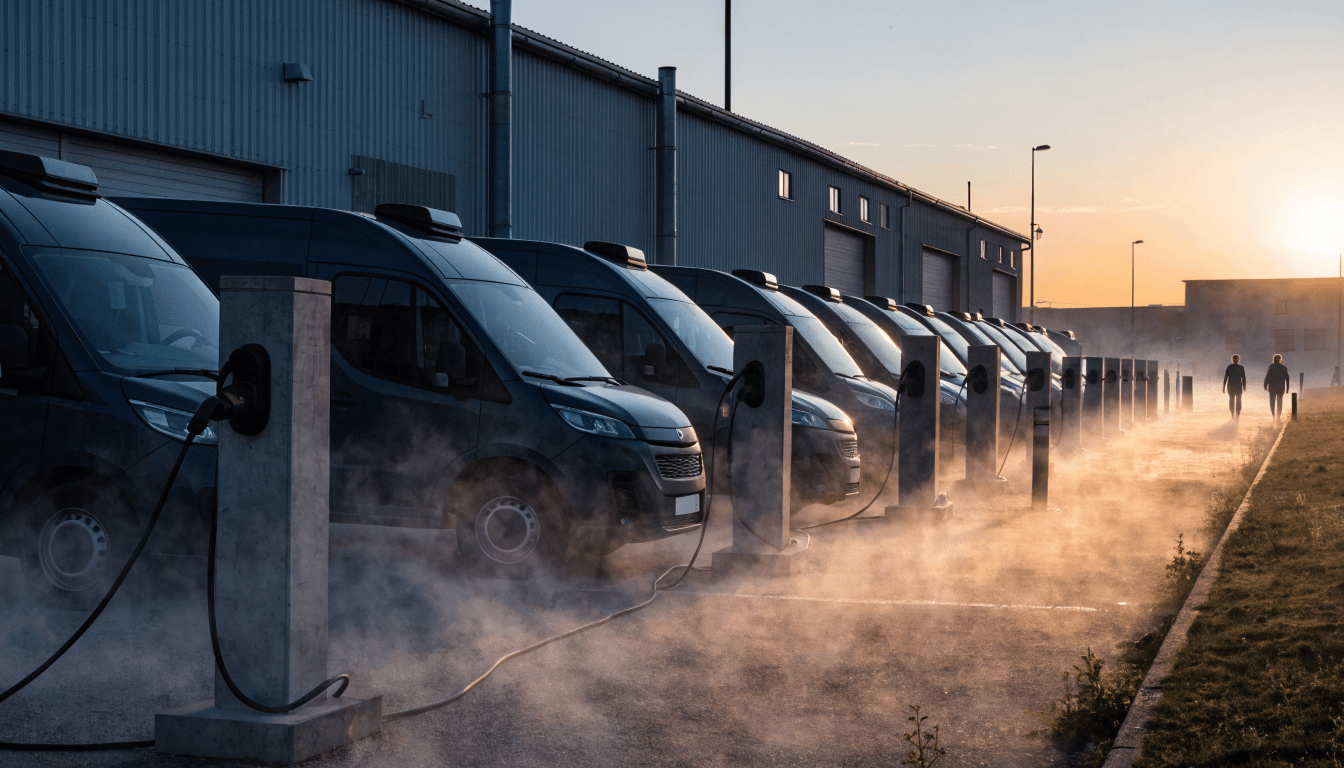
The Depot Charging Scheme pays 70% of eligible cost up to £1,000,000 per applicant for fleet EV infrastructure. The window closes 30 June 2026, with a likely successor scheme still TBC. To qualify you need a minimum of 5 vehicles or an HGV operator licence, and the depot has to be operator-controlled. Yet uptake is materially lower than the available budget. The reason isn't that the maths is bad — on a 30-van depot it turns a £180,000 project into a £54,000 net spend with payback in under two years on diesel savings alone. The reason is OZEV form 4b, the application document, which has acquired a reputation as a small-business war crime. That reputation is mostly out of date. The 2024 revision is materially better. The villain in this post is form 4b's reputation, not form 4b itself.
If you run a fleet, this is the grant. Here's how it actually works.
What the Depot Charging Scheme actually is
Launched by the Office for Zero Emission Vehicles to plug the obvious gap left by the Workplace Charging Scheme — which caps at £20,000 and was never designed for fleet depots — the DCS is the heavyweight grant in the OZEV portfolio. The 2026 numbers:
- 70% of eligible cost, capped at £1m per applicant.
- Minimum 5 vehicles in the operator's fleet, or a valid HGV operator licence.
- The depot must be operated by the applicant, not a third-party site they happen to park at.
- One application per depot; multiple depots per applicant allowed up to the £1m group cap.
- Installs must complete within a defined window (typically 12 months from award) or the grant is forfeited.
- Window closes 30 June 2026 for new applications. After that, you're waiting for the successor scheme, the timeline for which has not been confirmed.
That last point is the one nobody acts on until it's too late. There is a real cliff edge here. If you've been thinking about it, this is the year. Specifically, this is the next four months.
What counts as eligible cost (and what doesn't)
This is the part where applications get rejected or trimmed, so it's worth being precise.
Eligible:
- Hardware — the chargepoints themselves, AC or DC, including network-connected units.
- Installation labour — electricians, civils contractors, project management.
- Civils — trenching, ducting, concrete bases, bollards, line-marking, drainage where required.
- Switchgear — distribution boards, isolators, metering and protective devices specific to the install.
- Transformer upgrade — if a new or upgraded transformer is required to support the load, this is eligible. (DNO reinforcement charges are typically eligible; double-check the latest guidance for your specific case.)
- Substation works — where the install requires.
Not eligible:
- The vehicles themselves. Different scheme. Sorry.
- Operational comms costs — your ongoing SIM, OCPP back-office subscriptions, maintenance contracts after install.
- Ongoing maintenance — covered separately, not as capex.
- Office Wi-Fi, IT systems, telematics, fleet management software — even if they integrate with the chargers.
- Land purchase or remediation — applies to capex on chargers, not on the depot itself.
- Anything claimed under another OZEV scheme — the no-double-funding rule applies per socket.
The line between eligible and ineligible is genuinely clear in the 2026 guidance, but it requires your installer to itemise the quote properly. If you get a one-line quote, you'll get a smaller grant. Insist on itemisation.
Who qualifies — the short answer
If you're answering yes to one or more of the following, you're in:
- I operate a fleet of 5 or more vehicles — vans, cars, HGVs, buses, minibuses, refuse trucks, anything road-legal.
- I hold a standard or restricted HGV operator licence.
- I control the depot or yard where the chargers will be installed — owned, leased, or licensed with rights to install.
- I'm a UK-registered organisation — limited company, LLP, partnership, sole trader, charity, or public-sector body.
- I haven't already maxed out the £1m per-applicant cap across previous awards.
That covers most logistics operators, local authorities, NHS trusts, bus operators, taxi fleets, service-engineer fleets, last-mile delivery companies, refuse contractors, courier networks, and traditional fleet operators with five or more vehicles. The bar is low. The grant is high. The window is closing.
Form 4b: the walkthrough
Form 4b is OZEV's structured application for DCS. It is genuinely long. It is not, contrary to its reputation, designed by people who hate small businesses — though it was clearly drafted by people who were under deadline. Most applications, with the right paperwork in front of you, take three to four hours. Not the week your finance team is bracing for.
What it actually asks for:
Section 1: Applicant identity. Companies House number or equivalent, VAT registration, registered address, contact, operator licence number if you have one.
Section 2: Fleet and operations. Vehicle count by type, current fuel mix, planned EV transition timeline, depot list.
Section 3: Site details. Specific depot address, ownership/lease evidence, planning consent status, existing electrical supply.
Section 4: The technical project. Number of chargepoints, power per unit, total kW demand, anticipated daily energy throughput, comms and back-office.
Section 5: Itemised cost breakdown. Eligible vs ineligible lines, separately. This is the section that gets trimmed if your installer hasn't done the work properly. Insist on a clean spreadsheet.
Section 6: Timeline. Start date, completion date, milestone schedule. Be realistic — slippage past your committed completion can forfeit the grant.
Section 7: Subsidy Control / State Aid declaration. This used to be the bit that scared finance directors. Post-Brexit, the Subsidy Control Act 2022 governs this — and for most applicants under £315,000 cumulative subsidy over three years it's a tickbox. Larger awards need more documentation; talk to your installer or accountant.
Section 8: Declarations and signatures. Director sign-off. Get the right person to do this. Don't have your office manager declare on behalf of the board.
Most of what slows form 4b down is collecting the supporting documents, not filling in the form. Have the following ready in advance and you'll save days:
- Last three years of statutory accounts.
- Operator licence (if HGV).
- Lease, deed, or letter of authority for the depot.
- Itemised installer quote with eligible/ineligible breakdown.
- DNO confirmation (or in-progress reference) that the supply can take the load.
- Planning status — most depot installs are permitted development but check.
- Insurance certificates for the install contractor.
A worked example — a 30-van last-mile depot
Site: Outskirts of Manchester. 30-van last-mile delivery depot. Diesel fleet, transitioning to electric over 18 months. Brief: 30 × 22kW AC twin-socket chargers, overnight depot charging only, no public access.
The quote, itemised for eligible cost:
- 15 × 22kW twin AC chargers (30 sockets), comms, 5-yr warranty: £75,000
- Civils, trenching, ducting, concrete bases, line-marking, 40m runs: £32,000
- Switchgear, distribution, protection, metering: £24,000
- DNO-driven transformer upgrade (modest, sub-200kVA): £28,000
- Installation labour (electricians, civils crew, PM): £18,000
- Sign-off, certification, commissioning: £3,000
- Subtotal, eligible cost: £180,000
Grant applied:
- DCS at 70% of £180,000 = £126,000
- Net capex before tax: £54,000
- 100% First-Year Allowance on the £54,000 net capex at 25% corp tax: ~£13,500 tax saving
- Effective net cost in year one: ~£40,500
Operating savings:
- 30 vans averaging 60 miles/day, 250 working days/year = 450,000 miles/year.
- Diesel cost at 28 mpg, fuel at £1.45/litre: roughly £105,000/year on fuel.
- Electric equivalent on depot tariff at 13p/kWh, real-world efficiency 3.5 mi/kWh: roughly £17,000/year on electricity.
- Annual fuel saving: ~£88,000.
Payback on the net capex (£40,500) from fuel alone: under 6 months. Even on the gross £180,000 before grant: just over 2 years. After grant, even charitably costed, it's an open goal.
That's before BIK, before vehicle excise duty differences, before reduced maintenance costs on electric vans, before any contract terms with local-authority clean air zones that reward zero-emission delivery.
The deadline countdown
The DCS window closes 30 June 2026 for new applications. OZEV processes applications in roughly four to ten weeks. After approval, you have a defined install window — typically 12 months — to complete and claim. Backing into that timeline:
- Apply by end of April 2026 to be comfortable.
- Apply by end of May 2026 if you're confident your paperwork is ready.
- Apply in June 2026 at your peril — the queue will be enormous as everyone realises the window is closing.
- Apply after 30 June 2026 and wait for the successor scheme. Which will exist. Probably. With different rules. At an unspecified point in time.
The successor scheme rumour mill is interesting, but rumour mills don't pay for chargers.
What to ask before you sign
- "Have you applied for DCS before? Can I see a redacted approval?"
- "Will you split the quote into eligible and ineligible costs in writing?"
- "Who completes form 4b — you, me, or jointly?"
- "What happens to the grant if your install slips past the completion window?"
- "What's the DNO status on this site, and is the transformer cost in the eligible total?"
- "Are the chargepoints and your business on the current OZEV-approved lists?"
If those answers are confident and specific, you have an installer who has done this. If they're vague, find one who hasn't been winging it.
The short version
The Depot Charging Scheme pays 70% of eligible cost up to £1m. Closes 30 June 2026. Minimum 5 vehicles or HGV operator licence. Form 4b takes a few hours with the right paperwork, not the week of your life that the rumour mill suggests. On a 30-van depot, a £180k project becomes a £40.5k net spend after grant and tax, paying back in under six months on diesel savings alone. Apply now or wait for an unspecified successor scheme. Your call.
Want us to do the maths on your site?
Get a free fleet audit at /fleet-audit and we'll come back with a depot-by-depot grant application plan, a realistic award estimate, and a complete form 4b draft for your sign-off. We've done dozens of these. Including the Subsidy Control declaration. Especially the Subsidy Control declaration.
Fleet AuditRead this article in the app at energy-partners.co.uk/insights/depot-charging-scheme-2026. Energy Partners installs and manages commercial EV charging, solar and battery storage for UK venues — talk to us.