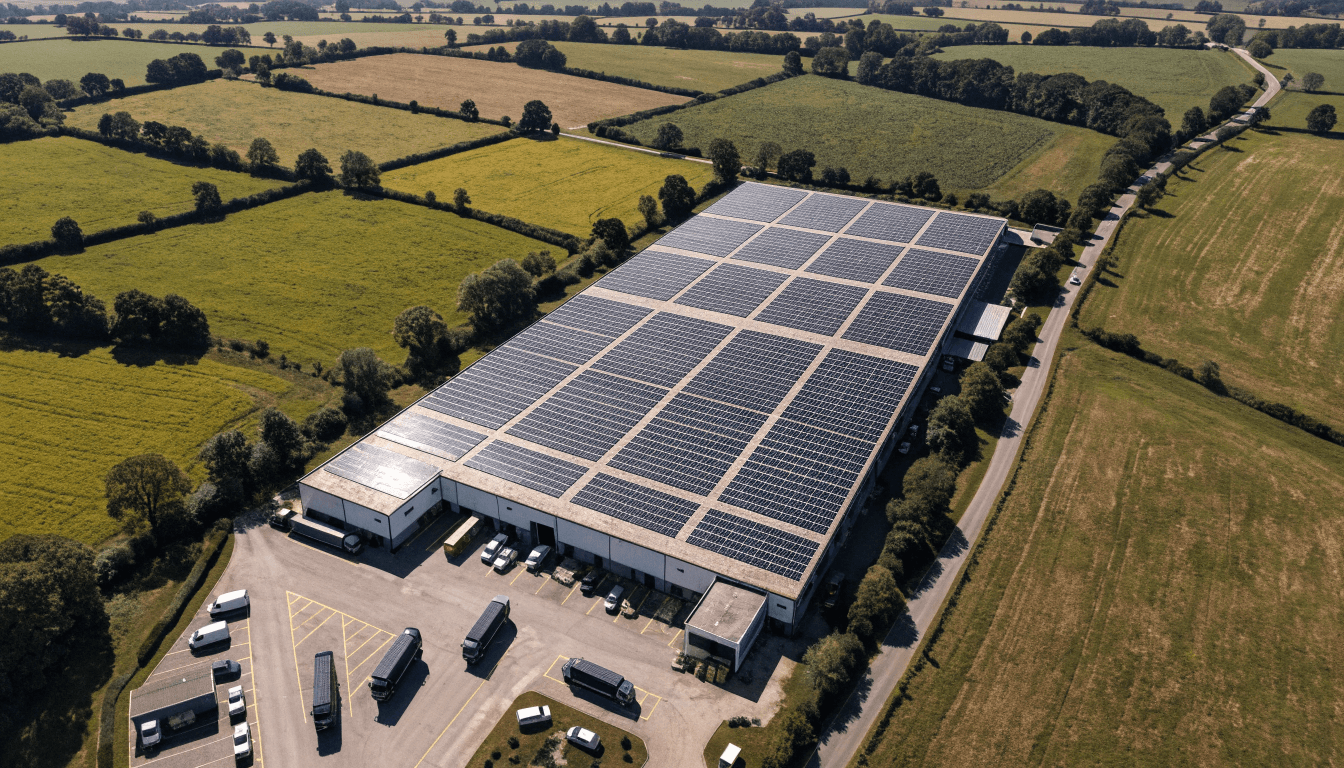
A typical UK industrial warehouse roof of 30,000 sq ft can host a 300kWp solar PV system generating around 285,000 kWh per year. At a realistic 2026 mix of self-consumption at 27p/kWh and Smart Export Guarantee export at 7p/kWh, that's roughly £63,000 of gross annual value. Capital cost in 2026 is £750–£900 per kWp installed at commercial scale — so £225,000 for that 300kWp system, all-in. With 100% first-year capital allowance under HMRC's CA22335 plant-and-machinery rules, you get roughly £56,000 back through corporation tax in year one. Payback in under four years. After year four, the roof generates north of £60,000 a year for the next twenty. The villain in this story is the combination of dead roof space and the standing-charge-heavy retail electricity contracts that have quietly drained industrial businesses since 2022.
You have an investment property on top of your building. Let's do the maths.
The numbers the energy broker won't show you
The reason most warehouses haven't installed solar isn't engineering — it's that the people advising them on energy are paid commission on retail electricity supply contracts, not on capex. Of course they don't lead with "stop buying my product and generate your own." That would be a strange sales pitch.
So let's lay out the inputs. For 2026, in the UK, on a commercial-scale install:
- Installed cost: £750–£900/kWp. That's the all-in number — panels, inverters, structural fittings, DC and AC cabling, isolation and metering, design and commissioning, sometimes including the structural survey. Volume drives the price down within that band; a 1MW install lands at the lower end, a 100kWp at the higher end.
- Generation (south-facing, modest pitch): roughly 950 kWh per kWp per year in the Midlands, 1,050 kWh/kWp in the South of England, lower in Scotland and the North West but not by as much as you'd expect. Modern panels are surprisingly tolerant of diffuse light.
- Self-consumption value: whatever your import tariff is, less any standing charge displacement. For most commercial users in 2026, 25–30p/kWh is the right number to use.
- Smart Export Guarantee (SEG) export value: 4–15p/kWh depending on which supplier you've negotiated with and how you've structured the export contract. The mid-market default is 6–8p/kWh.
That's the entire economic input. Everything else is execution.
The two numbers that change the answer — self-consumption ratio and tariff differential
Two variables move the maths more than any others.
Variable 1: How much of what you generate, you use. This is your self-consumption ratio. A warehouse with daytime operations, forklifts on chargers, lights on, refrigeration running and EV chargers in the car park will self-consume 70–85% of generation in real time. A purely overnight logistics operation might self-consume only 20–40% — the rest exports to the grid at SEG rates.
The difference matters enormously. Self-consumption is worth 25–30p/kWh to you. Export is worth 4–15p. A 5x value differential. So the maths on a daytime operation is dramatically better than on an overnight one — and the design lever you have is battery storage, which lets a night-shift operation behave economically more like a day-shift one.
Variable 2: Your import tariff and standing charge. If you're on a competitive industrial contract with low unit cost, the solar maths is good but not extraordinary. If you're on a Big Six default contract with the eye-watering standing charges that crept in after the 2022 price-cap restructuring, the solar maths is dramatic. Self-generated power doesn't just save the unit cost — it can, in some metering setups, reduce capacity charges as well. Get your most recent invoice in front of an installer and ask them to model it.
Structural and planning gotchas
This is the part most warehouse owners worry about. Mostly unnecessarily, sometimes legitimately.
Permitted development. Most non-listed industrial buildings in England fall under Class A permitted development rights for solar PV, meaning no full planning application is required for roof-mounted systems. Conditions apply — panels must not protrude above the roof ridge, must not be on the principal elevation in conservation areas, and standard rules about height and setback apply. In practice, the overwhelming majority of UK industrial roofs qualify. Listed buildings, conservation areas and Article 4 directions are the obvious exceptions.
Structural survey. Always required. Modern panels weigh roughly 12–15 kg/m² installed, which is well within most industrial roof load-bearing capacities — but you don't assume, you verify. A structural engineer's survey costs £800–£3,500 depending on roof complexity, size, and whether intrusive inspection is required. On older mineral-fibre or asbestos-cement sheet roofs, the picture is more complicated — sometimes solar drives a roof replacement decision that was due anyway. Get this assessment done before the design is locked in, not after.
DNO export consent. If you're exporting to the grid, the Distribution Network Operator needs to approve it under G99 or G98 regulations. For most commercial installs, this is a 6–12 week process, not free but not catastrophic. If your local network is constrained, the DNO may impose export limits or, occasionally, require reinforcement. Worth asking the installer to engage the DNO at design stage, not at the end.
Roof warranty interaction. If your roof has an active manufacturer warranty, mounting solar can affect it. The installer needs to use the manufacturer's approved fixing system and certify the install accordingly. Most reputable installers do this as standard. Ask explicitly.
Insurance. Your buildings insurance needs to be notified and updated for the solar install. Most policies handle it without fuss; some have specific PV exclusions. Check before commissioning, not after.
A worked example — a 300kWp install on a 30,000 sq ft warehouse
Site: Midlands logistics warehouse, 30,000 sq ft (≈2,800m²) roof area. Daytime operations, two shifts, electric forklifts on charge, EV chargers in the car park, refrigeration on a portion of the building. South-facing pitched roof, in good condition, asbestos-free.
The system:
- 300kWp solar PV install — roughly 600 modern 500W panels across ~2,000m² of usable roof area.
- Three-phase inverters, AC isolation, metering, MCS-certified design.
- DNO G99 application included.
The capex, itemised:
- Panels, inverters, mounting systems: £135,000
- Cabling, AC switchgear, isolation, metering: £24,000
- Installation labour, scaffolding, lifting: £42,000
- Design, project management, structural survey, DNO works: £15,000
- Commissioning, sign-off, MCS certification: £9,000
- Total capex: £225,000 (£750/kWp at the lower end of the 2026 band — appropriate for a clean, large, single-roof site)
Year-one revenue and savings:
- Generation: 300kWp × 950 kWh/kWp = 285,000 kWh/year
- Self-consumption at 70% × 27p/kWh = 199,500 kWh × 27p = £53,865
- Export at 30% × 7p/kWh = 85,500 kWh × 7p = £5,985
- Year-one gross: £59,850
Tax treatment:
- 100% first-year capital allowance under HMRC CA22335 on the £225,000 capex
- At 25% corporation tax: ~£56,250 reduction in year-one tax bill
Payback:
- Capex: £225,000
- Year-one tax saving: £56,250 → net capex £168,750
- Year-one operating value: £59,850
- Years 2-3 operating value (roughly): £58,000 + £56,000
- Cumulative payback: somewhere between year 3 and year 4.
After payback the system continues generating £55,000–£60,000 of annual value for another ~20 years (panel manufacturer warranties typically guarantee 80% performance at year 25), against negligible operating cost — annual inverter servicing, occasional panel cleaning, eventual inverter replacement at year 10–15 (~£18,000 on a system this size).
The 25-year gross lifetime value on the install is on the order of £1.2–1.4 million against an initial £225k. Net of tax, financing, maintenance and inverter replacement, the net present value at a sensible discount rate sits comfortably north of £700,000.
SEG vs self-consumption — the strategic tradeoff
If you can shift load to align with generation, do it. The 5x value differential between self-consumption and export is the single biggest economic lever in commercial solar. Practical examples:
- Forklift charging. Schedule midday charging cycles where possible.
- HVAC pre-cooling. Pre-cool buildings in late morning when generation peaks and ambient temperatures are climbing.
- EV chargers in the car park. Self-consumed daytime workplace charging at 27p of avoided import value vs 7p of export to the grid.
- Refrigeration. Where regulations and food safety allow, pre-cool storage during peak generation hours.
- Battery storage. The big one. A modest 100kWh / 50kW battery at roughly £60,000-90,000 installed lets a daytime-generating warehouse time-shift evening and overnight consumption, lifting self-consumption ratio from 70% to 85-90%. Payback on the battery alone is typically 5-7 years on an industrial site.
You don't have to do all of these. You should do at least some of them. Even moving self-consumption from 60% to 75% on the example above adds roughly £8,000/year in net value.
What to ask before you sign
- "What's the MCS certification status of the install, and who's the certifying installer?"
- "Can I see three references from comparable industrial-scale installs in the last 24 months?"
- "What's the structural survey scope, and is it included in the quote?"
- "What's the DNO G99 application status and timeline for this site?"
- "What's the panel manufacturer warranty, and what about the inverter warranty? Who handles claims?"
- "What's the self-consumption ratio you're modelling, and on what assumptions?"
- "What does the system generate in year 10 and year 20 on your degradation model?"
- "Is the install design optimised for current half-hour-settled commercial tariffs, including capacity-charge avoidance?"
If those answers are confident and specific, you have an installer who has done this at scale. If they hand you a glossy PDF with no numbers, you have a salesperson.
The short version
Typical UK warehouse roof, 30,000 sq ft, 300kWp install, £225,000 capex. Year-one operating value ~£60,000. Year-one tax saving via 100% FYA at 25% corp tax: ~£56,000. Payback under four years. Lifetime gross value over £1.2 million. Class A permitted development covers most non-listed industrial roofs. MCS certification required. Structural survey non-negotiable, £800–£3,500. DNO G99 export consent at design stage, not as an afterthought. The single biggest economic lever is self-consumption ratio — shift load to match generation, or add battery storage to shift generation to match load.
Want us to do the maths on your site?
Book a site survey at /site-survey and we'll come back with a roof-specific generation model, a transparent line-item quote, a draft G99 application, and a self-consumption shift plan tailored to your operations. Including the DNO bit. Especially the DNO bit.
Site SurveyRead this article in the app at energy-partners.co.uk/insights/commercial-solar-warehouse-uk. Energy Partners installs and manages commercial EV charging, solar and battery storage for UK venues — talk to us.