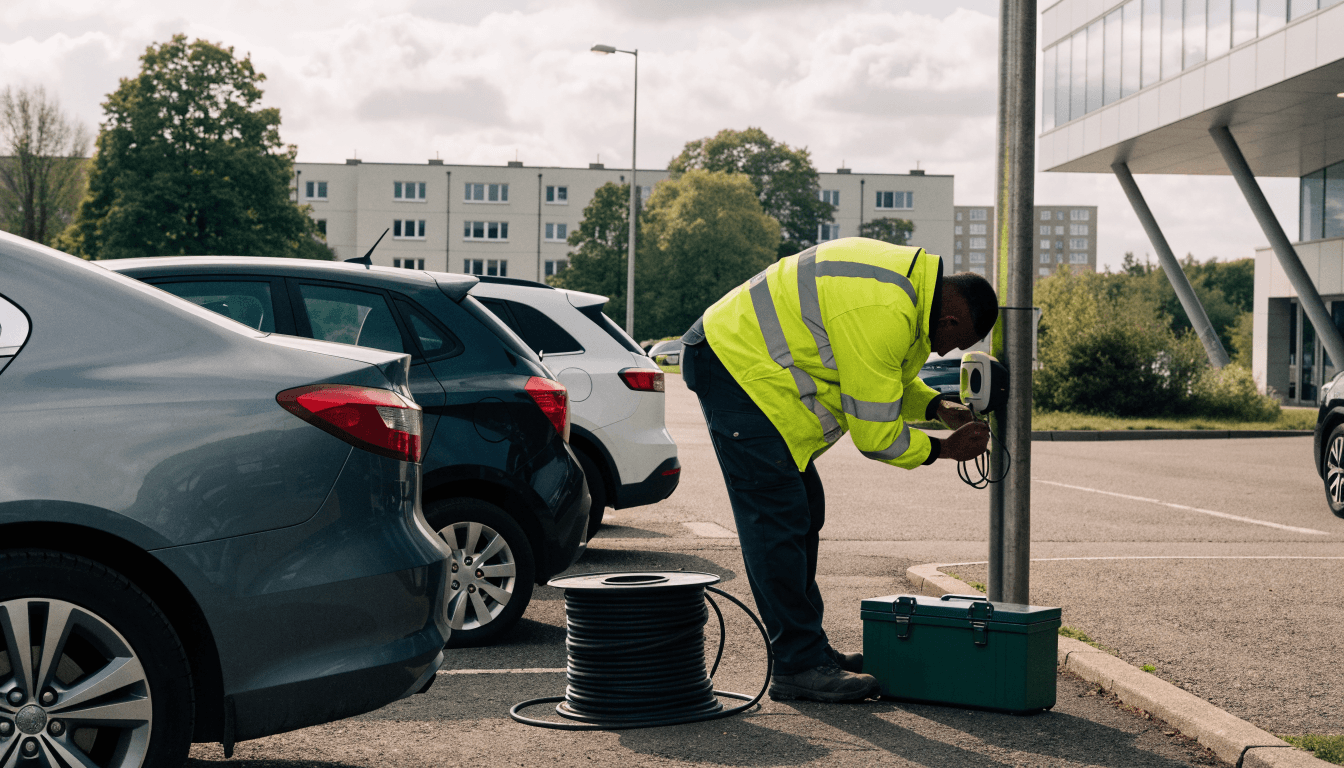
If you ring three EV charging companies tomorrow and ask "what does a 22kW twin-socket workplace charger cost, fully installed?", you'll get three answers: "depends," "let's get on a call," and a brochure that takes 90 seconds to load and contains no numbers.
We're going to do something heretical. We're going to publish the actual ranges. Real numbers, in real pounds, for a real 2026 commercial install in the United Kingdom. Bookmark this; you'll need it the next time someone tries to sell you a £4,000 "premium charging unit" that's the same hardware as a £1,200 one in a different colour.
Here's the punchline up front. A single 7kW workplace charger is £1,200–£2,200 installed. A 22kW twin is £3,500–£6,500. A 50kW DC rapid runs £25,000–£40,000. A 150kW ultra-rapid is £55,000–£90,000. The Workplace Charging Scheme will hand you £500 per socket toward it, capped at 40 sockets, and the Depot Charging Scheme covered 70% up to a million quid in its first window (the rate for Window 2 is still to be confirmed).
Now, the detail.
The 7 line items hiding in every quote
The reason quotes vary so wildly isn't margin (well, mostly). It's that installers either bundle these into one number or hide three of them off-quote and bill you for them later. Demand a line-by-line breakdown. If they can't or won't give it to you, walk.
1. The unit itself. £350–£1,800 for a 7kW. £900–£3,000 for a 22kW. £15,000–£28,000 for a 50kW DC. £35,000–£65,000 for a 150kW ultra-rapid. The spread is mostly about back-office software, network connectivity, payment hardware and warranty length — not the box.
2. Installation labour. £400–£900 for a 7kW. £700–£1,500 for a 22kW. £1,500–£3,500 for DC units (more electricians, more time, more PPE).
3. Civils. Trenching, ducting, concrete bases, bollards, line-marking. £150–£600 per metre of trench, and that adds up faster than anyone tells you. A 30-metre cable run from a building to a car park edge isn't unusual, and that's £4,500–£18,000 right there.
4. DNO application. The Distribution Network Operator decides whether your local grid can take what you want to install. The application itself is free-to-low-cost (£0–£500); the upgrade they might insist on is not. More on that in a minute.
5. Networking and comms. The SIM card, the OCPP back-office subscription, the integration into your fleet or facilities management software. £40–£180 per charger per year, ongoing.
6. Payment terminal (where required). For public-facing destination chargers, regulation now requires contactless payment on units 8kW and above. £400–£1,200 per terminal, plus card-acquiring fees on each transaction.
7. Maintenance contract. Optional in theory, mandatory in practice if you want the 99% uptime your tenants, customers or staff will demand. £150–£500 per charger per year for monitoring, parts SLA and call-outs.
That's seven lines. Most quotes show you two — unit plus install — and the rest land as "variations" three months in.
What it actually costs by charger type
7kW AC, single socket — the workplace workhorse. £1,200–£2,200 fully installed for a straightforward run. Smart-charger compliant. Good for staff vehicles plugged in for six hours or more.
22kW AC, twin socket — destination car parks, retail, hospitality. £3,500–£6,500 installed per unit. Needs three-phase supply, which is the bit that bites: if your site only has single-phase, you're paying for an upgrade before you've started.
50kW DC rapid — fleet depots, forecourts, time-poor destinations. £25,000–£40,000 installed. The price tag suddenly includes ground works, weather-rated cabinets and the DNO sitting up and paying attention. A 50kW unit pulls roughly the same demand at peak as 22 average UK households. Grids notice.
150kW+ ultra-rapid — motorway services, HGV depots, rapid hubs. £55,000–£90,000+ installed per unit, before grid reinforcement. A six-stall hub can easily breach £500,000 once you've factored in transformer upgrades and switchgear. This is where Depot Charging Scheme funding earns its keep.
The hidden costs nobody puts on the brochure
Here come the things that turn a £15,000 quote into a £45,000 invoice.
Grid upgrade. If your existing connection can't take the new load, the DNO will quote you a reinforcement. This can be £5,000 for a fuse upgrade. It can be £180,000 for a new transformer. We've seen both, on sites that looked identical from the road.
Half-hourly metering. Add a few large chargers and you may cross the threshold that forces a meter change. New meter installation: £300–£900. New tariff structure with capacity charges: potentially thousands a year. Talk to your energy broker before you commit, not after.
Signage and lighting. Often overlooked, often required by planning. £200–£1,500.
Insurance. Your buildings insurance may need updating to reflect the new infrastructure. Almost always cheaper than expected. Almost always forgotten until renewal.
Civils surprises. Buried Victorian water mains. Unmapped fibre. Asbestos in soffits where the cables need to enter. Budget a 10–15% contingency. You will use it.
How grants actually change the maths
The Workplace Charging Scheme rose to £500 per socket on 1 April 2026, capped at 40 sockets per applicant, covering up to 75% of total costs. That makes most workplace installs roughly cost-neutral in cash terms over a 5-year window once you factor in fuel savings on the cars that use them.
The Depot Charging Scheme is a £170m multi-year programme running from April 2026 to 2030. Its first window paid 70% of eligible cost, up to £1m per applicant, and closed on 30 June 2026. Window 2 is expected to open on 28 October 2026 and close on 29 January 2027, with £38m available for projects starting from April 2027 and delivered by 31 March 2028. The terms and grant rates for Window 2 haven't been confirmed yet, so don't bank on 70% until they are. Applications have been assessed first-come-first-served — if you're a fleet operator, have your site survey and quote ready before 28 October so you can apply the day it opens.
Capital allowances are doing quiet heavy lifting in the background too. Most charging infrastructure qualifies for 100% first-year allowance. Talk to your accountant; they probably haven't read the latest HMRC guidance either.
A worked example, because that's what you actually wanted
Site: Mid-sized office, 80 staff parking spaces, semi-urban Midlands. Brief: 6-socket workplace charging, future-ready for a small pool-car fleet.
The quote before grants:
- 6 × 22kW twin AC chargers, including comms and 5-yr warranty: £24,000
- Three-phase supply upgrade (modest, no DNO reinforcement needed): £4,800
- Civils, 25m trench, marking, bollards: £8,200
- Network, payments (one terminal, members-only): £1,400
- Maintenance, year one: £1,800
- Project management, sign-off, certification: £2,200
- Subtotal: £42,400
Grants applied:
- WCS: 12 sockets × £500 = £6,000
- Capital allowance on £42,400: ~£10,600 tax saving (assuming 25% corporation tax)
- Effective net cost in year one: ~£25,800
That's roughly £4,300 per socket, all-in, after grants and tax. The fuel savings on a small EV pool fleet using it will typically pay that back in two to three years, before you factor in BIK savings or the talent-acquisition halo that a charging-equipped office gets in 2026's recruitment market.
What to ask before you sign
- "Show me the 7-line cost breakdown above for this exact quote."
- "What's your DNO application status — have you contacted them yet?"
- "What's the warranty length and who honours it if you go bust?"
- "Is the unit OCPP open-protocol, or am I locked into your back-office forever?"
- "What's your actual uptime number — not the headline, the SLA-credited one?"
If those questions get you straight answers, you're talking to a real installer. If they get you "depends" three times, you're talking to a brochure.
The short version
Plan on £1,200–£2,200 for a 7kW workplace post. £3,500–£6,500 for a 22kW twin. £25,000–£40,000 for a 50kW DC. Add 10–15% contingency. Apply for the grants you qualify for — Depot Charging Scheme Window 2 is expected to open on 28 October 2026 and close on 29 January 2027. Audit the quote line by line. And refuse — politely, firmly, possibly with biscuits — to accept a quote that doesn't tell you what you're paying for.
Want us to do the maths on your site? Run your postcode through our grant eligibility checker and we'll come back with a transparent line-item quote in five working days. Including the DNO bit. Especially the DNO bit.
Sources
- gov.uk/guidance/changes-to-electric-vehicle-chargepoint-grant-schemes-from-1-april-2026
- find-government-grants.service.gov.uk/grants/workplace-charging-scheme-2
- find-government-grants.service.gov.uk/grants/depot-charging-scheme-1 (Window 2 dates, funding and delivery deadline; checked 3 October 2026)
Read this article in the app at energy-partners.co.uk/insights/commercial-ev-charger-cost-uk-2026. Energy Partners installs and manages commercial EV charging, solar and battery storage for UK venues — talk to us.