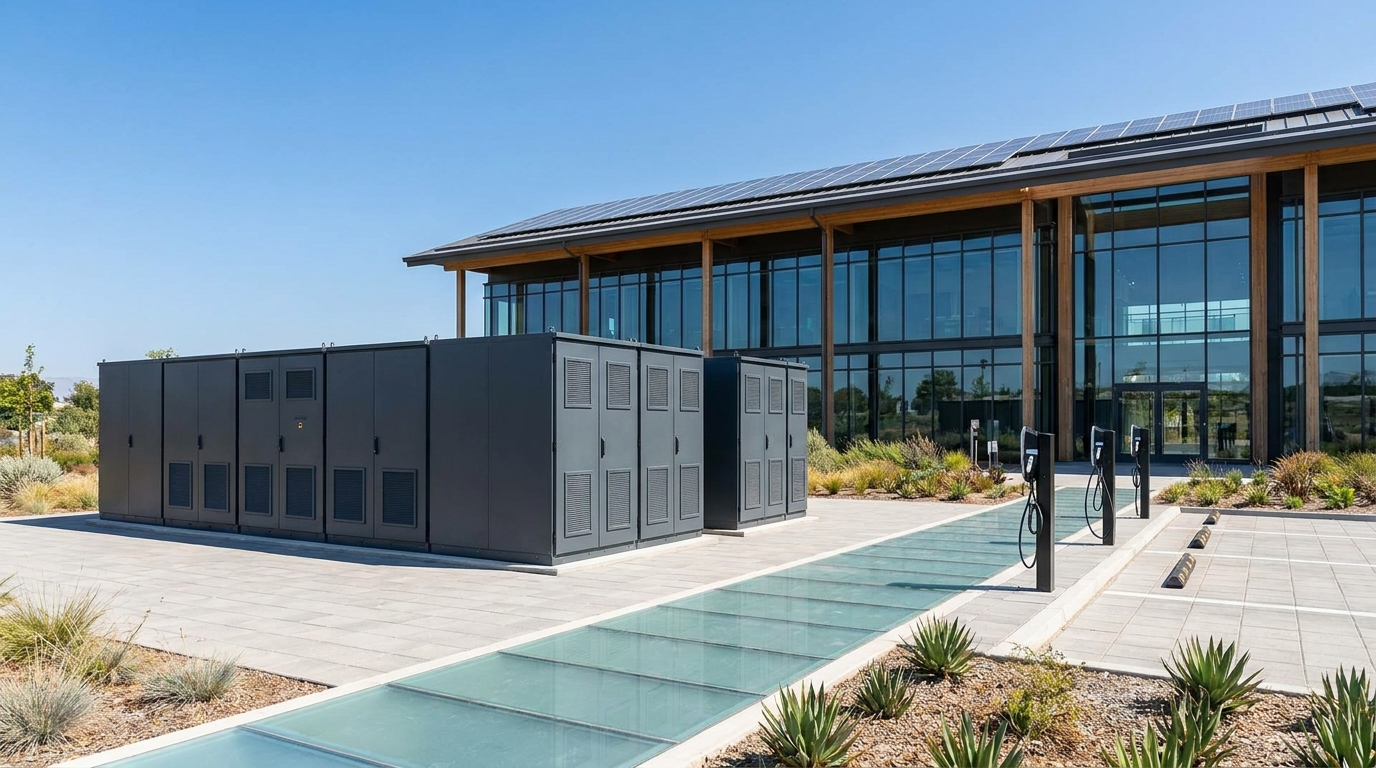
Commercial battery storage isn't funded by a grant — it pays for itself through avoided peak costs, stacked grid revenue and tax relief. Here's how the business case works in 2026.
Why businesses are adding battery storage
Electricity is expensive and volatile: non-domestic prices have run around 30–45p/kWh, with peaks above 50p. A commercial battery lets you store cheap or self-generated power and use it when grid power is most expensive — turning that volatility into savings. Paired with solar, it stores daytime generation for evening use instead of exporting it cheaply.
How it's funded
Like commercial solar, there's no single battery "grant" — the funding comes from three places:
- Tax relief. The Annual Investment Allowance gives a 100% first-year deduction on the first £1m of qualifying capital spend, and battery storage qualifies as plant and machinery. (Confirm your position with your accountant.)
- Savings + revenue (below).
- £0-upfront financing — lease and power-purchase structures let you install with no capital outlay and pay through the savings.
The revenue & savings stack
- Peak-price avoidance: charge when power is cheap, discharge at peak — the core saving for most sites.
- Avoiding red-band network charges (DUoS): shifting load out of peak windows cuts distribution charges.
- Solar self-consumption: store your own generation instead of exporting it at a lower rate.
- Resilience: keep critical systems running through outages and peaks.
- Grid revenue (larger systems): batteries can "stack" income across flexibility services, energy arbitrage and the capacity market — though these revenues vary with the market and suit bigger installations.
Is it worth it?
For most commercial sites the answer is driven by your peak consumption and price spread — the bigger your peak bills, the faster a battery pays back, especially alongside solar. A site survey models your specific load profile and the realistic saving.
→ Book a free battery storage site survey
Frequently asked questions
Is there a grant for commercial battery storage? Not a single national capital grant. The business case is built on tax relief (Annual Investment Allowance), avoided peak/network costs, solar self-consumption, and £0-upfront financing.
Can battery storage earn revenue? Yes — larger systems can stack income from grid flexibility services, energy arbitrage and the capacity market, on top of the savings from avoiding peak prices.
Does it work with solar? Yes — batteries store surplus solar for use when the sun isn't shining, increasing self-consumption and shortening payback.
The bottom line
Battery storage in 2026 is a savings-and-resilience play funded by tax relief and £0-upfront finance, not a grant. Whether it pays back in a few years depends on your load profile — a survey is the way to find out.
General information only, not tax or financial advice — confirm your position with a qualified accountant. Figures reflect public market data as of June 2026 and change over time.
Site SurveyRead this article in the app at energy-partners.co.uk/insights/commercial-battery-storage-uk-2026. Energy Partners installs and manages commercial EV charging, solar and battery storage for UK venues — talk to us.